

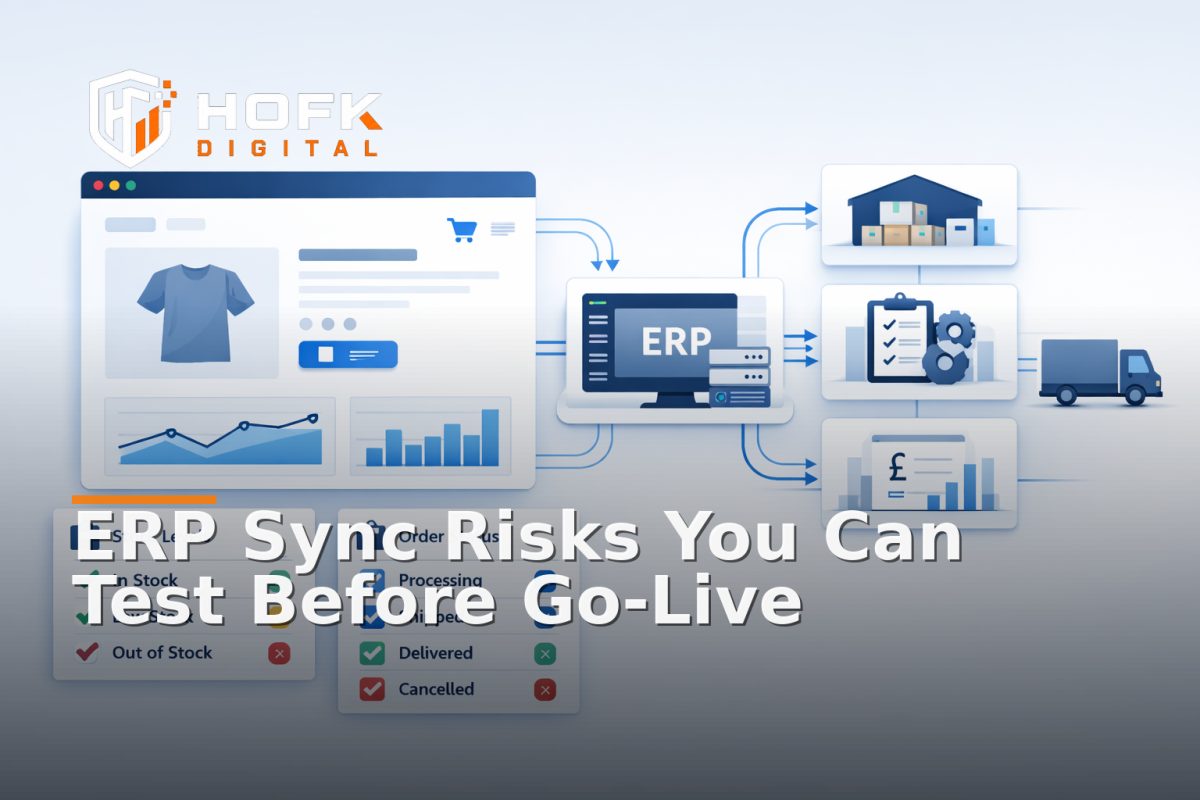
How to Build an ERP Sync Risk Matrix for Ecommerce Replatform Launches
A replatform launch can look healthy right up until the moment ERP data starts moving through the new stack. The site loads, the pages render and the checkout seems fine, but product, stock, pricing or order-state data may already be drifting out of sync. That is why a replatform migration QA matrix should not be treated as one large checklist. It should be narrowed down to one critical ERP-connected flow and tested with the kind of failure points that actually break trading.
If you try to test everything at once, the important issues get lost. A better approach is to build an ERP sync risk matrix around one launch-critical path, such as product data, stock updates, pricing integrity or order-state reconciliation. That makes the test plan sharper, the owners clearer and the go/no-go decision much easier.
This article is for technical delivery leads, developers, QA teams and ecommerce operations managers planning a CMS or ecommerce replatform. The focus is deliberately narrow: how to reduce migration risk by mapping one ERP-dependent flow, identifying where it can fail, and deciding what must be verified before cutover.
Start by choosing one ERP-connected flow
A replatform launch becomes much easier to control when you stop treating ERP integration as one giant problem. Pick one flow that matters commercially and operationally, then build the matrix around that flow only.
The best candidates are usually:
- product creation and catalogue sync
- stock availability and replenishment sync
- pricing and promotional price sync
- order-state sync from storefront to ERP
If you are supporting a trade site, a marketplace feed, or a store with multiple fulfilment rules, you may have several ERP-connected paths. Do not mix them in version one of the matrix. Choose the flow that would cause the most damage if it drifted at launch.
For example, if pricing is controlled in the ERP and the new site renders pricing on multiple templates, the pricing flow is the one to test first. If stock is the business-critical signal because the catalogue moves quickly, prioritise stock sync. The matrix works best when it is specific enough to expose one failure mode properly.
Define the business truth before the technical truth
Before you write tests, write down what the business considers true for that flow. The ERP, the ecommerce platform and the customer-facing page may each describe the same thing differently. Your matrix needs a source of truth for each step.
Ask:
- Which system owns the field?
- Which system is allowed to overwrite it?
- Which state is visible to customers?
- Which state is used for operations or fulfilment?
For a product flow, that might mean the ERP owns SKU, base price and stock, while the storefront controls merchandising copy and product page layout. For an order-state flow, the storefront may create the order, but the ERP becomes the operational record after payment or handoff.
If the team cannot agree on the business truth, the QA matrix will only tell you that the systems disagree. It will not tell you which one is wrong.
Build the ERP sync risk matrix around failure types
A useful matrix is not just a list of tests. It is a map of where the integration can fail, how serious the failure is, and how quickly the team needs to know about it. That is what makes it a practical replatform migration QA matrix rather than a generic checklist.
1. Data loss
This is where a field disappears, truncates or fails to arrive in the new system. Examples include missing SKUs, blank stock values or incomplete order references. Data loss is usually a launch blocker if it affects trading or fulfilment.
2. Data drift
Data drift happens when the same value exists in both systems but no longer matches. A price may be correct in the ERP but stale on the storefront. A product may be active in the ERP but hidden on the site. Drift is often subtle and easy to miss without a targeted test.
3. Timing failure
Timing failures are common during replatform launches because the sync schedule, cache refresh and API response times are not aligned. The data may be correct eventually, but not at the point the customer sees it. That is still a trading problem.
4. Mapping failure
Mapping failures happen when a field means one thing in the ERP and another thing in the new platform. This is common with stock statuses, price types, fulfilment labels and order states. The data arrives, but the receiving system interprets it incorrectly.
5. State transition failure
State transitions are where a record moves from one commercial state to another: reserved to allocated, pending to confirmed, on hold to active, or paid to dispatched. If the new platform does not honour those transitions cleanly, the process may look fine on the surface but fail operationally later.
Score each risk by impact and detectability
Once the failure types are clear, score each one using two simple measures:
- Impact – what happens to trading, fulfilment or customer trust if this fails?
- Detectability – how quickly will the team notice before damage spreads?
That gives you a practical way to prioritise the matrix. A high-impact, low-detectability issue is the thing you want to catch first.
For example, if stock drift means you can oversell a fast-moving item and nobody notices until fulfilment, that is high impact and low detectability. If a product title is slightly inconsistent but the price and stock are fine, that may be lower impact, even if it still needs fixing.
Use the matrix to rank issues like this:
- Critical – causes wrong customer promise, bad order creation or operational failure
- High – causes inaccurate data on the site or in the ERP, but may still be recoverable quickly
- Medium – causes inconsistency that affects reporting or manual work, but not immediate trading
- Low – visible mismatch that is annoying but not commercially damaging
Use a three-column test structure
A fail-safe matrix is easier to run if each test is written in the same format. For every risk, define:
- What should happen – the intended behaviour in the ERP-connected flow
- What could go wrong – the specific failure you are trying to catch
- What proves it is safe – the evidence required to pass the test
For a stock sync flow, that might look like this:
- What should happen: ERP stock updates should appear on the new product page within the agreed refresh window.
- What could go wrong: the site continues to show old stock after the ERP change.
- What proves it is safe: the ERP, the export or API response and the storefront all show the same value in the same test window.
For an order-state flow, it might look like this:
- What should happen: a paid order should move from the storefront into the ERP with the correct state.
- What could go wrong: the ERP receives the order, but the state is still pending or mapped incorrectly.
- What proves it is safe: the order reference, payment state and ERP status all match the intended transition.
Test the edge cases that launches usually expose
Replatform launches tend to fail at the awkward points, not the happy path. Your matrix should include edge cases that are easy to miss in a standard QA pass.
Useful edge cases include:
- one product with a clean record and one product with variant complexity
- a low-stock item that changes state during the sync window
- a promotional price that differs from the base price
- an order that is amended after submission
- an item that is discontinued in the ERP but still visible in a cached page
If the chosen flow is product sync, test a single-SKU item and a variant-heavy item. If the flow is stock, test a fast-moving item and a slow-moving item. If the flow is order-state, test the normal payment route and one exception route, such as an amended or cancelled order.
Write the matrix so people can act on it
A QA matrix only helps if it tells the team what to do next. For each test, note the owner and the action threshold.
A practical matrix row might include:
- flow
- risk type
- test scenario
- expected result
- owner
- severity if it fails
- go-live decision
That structure matters because launch teams often get stuck debating who should fix the issue. If the matrix already says who owns the ERP side, who owns the storefront side and who owns the release decision, the conversation is faster and calmer.
For example, a pricing drift test might be owned by the ecommerce manager and the developer responsible for the sync layer, while the release decision sits with the delivery lead. A state transition failure may involve QA, operations and development, but the escalation route should still be obvious.
Keep the release window narrow
The best replatform launch tests are time-boxed. ERP-connected issues often appear in the gap between deployment and stabilisation, so the matrix should not be left open-ended.
Define:
- when the test starts
- how long the sync is expected to settle
- when the team reviews the first result
- when the final go/no-go decision is made
This matters because a sync can look wrong in the first minute and correct itself later, or vice versa. The team needs a clear rule for what counts as acceptable delay and what counts as a launch problem. VERIFY: the correct timing depends on your own sync design, cache policy and operational tolerance.
Do not blur ERP sync QA with overall migration QA
One of the easiest ways to lose focus is to fold the ERP test into a broad migration checklist. That makes the launch feel comprehensive, but it also makes it harder to see whether the ERP path itself is safe.
General migration QA may cover redirects, templates, accessibility, search, analytics and payment. Those are important, but they are different risk areas. Your ERP sync risk matrix should stay narrow enough to answer one question: is the critical ERP-connected flow safe to launch?
That distinction is useful for teams planning an ecommerce replatform, because it avoids false confidence. A site can pass a broad QA sweep and still fail on product availability, order-state handoff or pricing accuracy.
A practical example of a one-flow matrix
Here is a simple example for a stock sync flow:
- Risk: stale stock on the storefront
- Failure type: data drift
- Test: update stock in the ERP and compare the storefront value after the agreed refresh window
- Pass evidence: the ERP and storefront show the same stock value, and the change is visible in the expected window
- Owner: ecommerce ops and developer
- Severity: high
For a pricing flow, the same approach might test whether a sale price survives through the export, the storefront and the checkout total. For an order-state flow, the test may check whether a paid order is written back with the correct status and reference.
Use the matrix to reduce migration risk, not just document it
The point of the matrix is not to create more paperwork. It is to help the team decide where to test, what to fix first and what must stop a launch. That is what makes it useful for migration risk reduction.
If a test fails, the matrix should already tell the team whether the issue is:
- a hard stop before go-live
- a fixable issue with a clear owner
- a monitor-only issue that can be reviewed after launch
That decision framework is especially useful when multiple teams are involved. Ecommerce, development, operations and QA can all see the same risk grading and work from the same evidence.
Where HOFK fits
HOFK works across ecommerce, platform migration and replatforming work, full stack development, automation, website monitoring and operational software. In projects like this, the useful work is often not just writing tests. It is narrowing the launch risk to the flow that matters, tracing where data can drift and making the handoff easier to trust.
In practical terms, that may mean mapping the ERP-connected flow, building the test matrix, checking sync timing, validating state transitions or making the interface easier to monitor after go-live. For teams that need a technical partner who understands both ecommerce and operational detail, that combination can make the launch safer.
Conclusion
If you want a safer replatform launch, build a replatform migration QA matrix around one critical ERP-connected flow rather than trying to test the whole site as one block. Choose the flow that matters most, define the business truth, score the failure types, test the edge cases and make ownership explicit.
That is the practical way to protect an ERP-connected launch from product, stock, pricing or order-state failures. The matrix should help your team see where the risk really sits, what must be fixed before cutover and what can be watched after launch. If you need support shaping the ERP side of a replatform, HOFK can help with full stack development, ecommerce support, automation and the implementation detail behind more reliable connected systems.
Suggested next step: choose one ERP-connected flow, list its top five failure modes and turn them into a testable matrix before the next release meeting.
Related terms: ecommerce migration QA, ERP connected replatform testing, migration risk reduction.
Published: 2026-07-21
Excerpt for archive: A practical guide to building a fail-safe ERP sync risk matrix for one launch-critical flow, so ecommerce teams can test the right failure points before cutover.
VERIFY: exact sync windows, state names and handoff behaviour vary by ERP, ecommerce platform and middleware setup.
Suggested internal links
- How to Protect ERP-to-Ecommerce Product Data During Replatforms Before Feed Drift Hits Sales
- How to Manage API and Feed Version Changes Safely in Retained Ecommerce Development
- How to Build Post-Deploy Payment Handoff Smoke Tests for Shopify, Magento and Laravel Ecommerce Stacks
- How to Build a Merchant Centre Feed Launch Sign-Off Process for Paid Shopping Campaigns
- Full stack development
- Ecommerce
Frequently asked questions
What is a replatform migration QA matrix?
A replatform migration QA matrix is a structured way to define what should be tested before an ecommerce or CMS launch, which failures matter most and who owns each issue.
Why narrow the matrix to one ERP-connected flow?
Because ERP sync problems are easier to find and fix when you focus on one critical path, such as product, stock, pricing or order-state reconciliation.
What should count as a launch blocker?
Anything that causes data loss, wrong customer promises, broken state transitions or trading risk should usually be treated as a blocker until resolved.
How is ERP connected replatform testing different from general QA?
General QA may cover the whole site, but ERP connected replatform testing focuses on the data that moves between systems and the risks that can affect trading.
Should the matrix include timing and sync windows?
Yes. Timing failures are common during launches, so the matrix should define when data is expected to settle and when a delay becomes a problem. VERIFY with your own setup.
What if the ERP and storefront disagree during testing?
Check which system owns the field, whether the issue is data loss, mapping, timing or state transition, and use the matrix to decide whether the issue blocks launch.
Frequently asked questions
What is a replatform migration QA matrix?
A replatform migration QA matrix is a structured way to define what should be tested before an ecommerce or CMS launch, which failures matter most and who owns each issue.
Why narrow the matrix to one ERP-connected flow?
Because ERP sync problems are easier to find and fix when you focus on one critical path, such as product, stock, pricing or order-state reconciliation.
What should count as a launch blocker?
Anything that causes data loss, wrong customer promises, broken state transitions or trading risk should usually be treated as a blocker until resolved.
How is ERP connected replatform testing different from general QA?
General QA may cover the whole site, but ERP connected replatform testing focuses on the data that moves between systems and the risks that can affect trading.
Should the matrix include timing and sync windows?
Yes. Timing failures are common during launches, so the matrix should define when data is expected to settle and when a delay becomes a problem. VERIFY with your own setup.
What if the ERP and storefront disagree during testing?
Check which system owns the field, whether the issue is data loss, mapping, timing or state transition, and use the matrix to decide whether the issue blocks launch.