

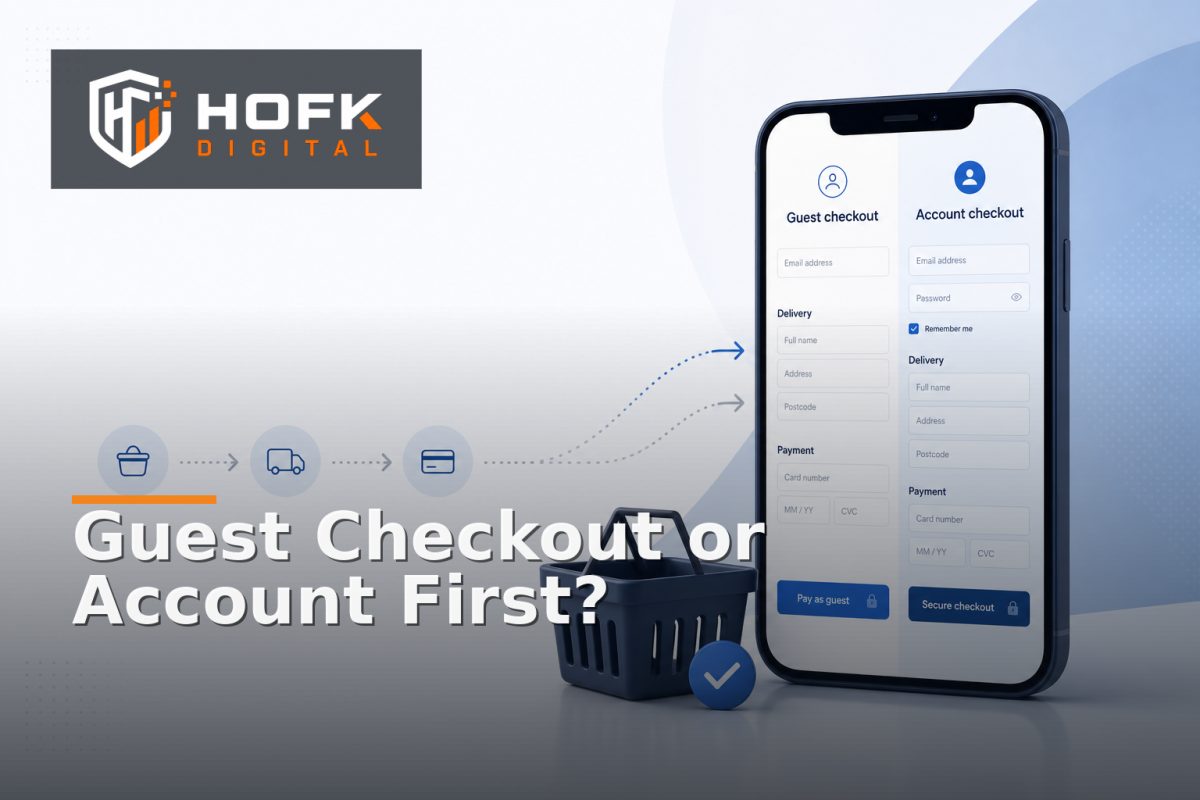
Guest Checkout vs Account Checkout: Which Is Better for Ecommerce Conversion?
A customer has chosen a product, reached checkout and is ready to pay. Then the site asks them to create a password before the order can be completed. Some customers will accept that step. Others will leave, particularly if they are buying for the first time or are not yet convinced they will return.
This is the practical question behind guest checkout vs account checkout: should a customer be allowed to complete an order without registering, or should account creation be part of the checkout process?
There is no universal answer. The right choice depends on repeat-purchase behaviour, customer-specific pricing, order history, fulfilment requirements, subscription features and how much friction the current checkout creates. This guide provides a practical way for UK ecommerce managers to compare the options and choose a checkout model based on evidence rather than preference.
What is the difference between guest checkout and account checkout?
Guest checkout lets a customer place an order using the information needed for payment and fulfilment, without creating a permanent login. The customer may receive an order confirmation and tracking information, but the account itself is optional.
Account checkout requires the customer to sign in or create an account before completing the order. This can provide access to order history, saved addresses, faster repeat purchasing and account-specific commercial rules.
There is also a useful middle ground: optional account creation. The customer completes checkout as a guest, then receives a clear invitation to create an account using the information already submitted. This avoids making registration a barrier while still giving the business a route to build an account relationship.
Start with customer intent, not internal preference
The first decision is to understand why people are buying from you. A one-off purchase and a repeat trade order should not necessarily use the same checkout model.
Guest checkout is often more suitable when:
- Many customers are new or arrive from paid campaigns.
- The purchase is relatively infrequent or low commitment.
- Customers do not need order history to make the purchase.
- The buying journey is mainly transactional rather than relationship-led.
- Account benefits are limited or difficult to explain.
Account creation may be more valuable when:
- Customers reorder regularly.
- Pricing, payment terms or product access depend on the customer account.
- Customers need saved delivery locations or order history.
- The business supports quotes, approvals or delegated ordering.
- There is a genuine post-purchase service reason for account access.
Do not force every customer into the same route if your audiences behave differently. A consumer checkout, a trade portal and a subscription purchase may need different account expectations.
Compare guest checkout vs account checkout by friction
Checkout friction is not limited to the number of fields on a page. Account creation can add several forms of effort:
- Choosing and confirming a password.
- Waiting for an activation email.
- Leaving checkout to verify an account.
- Recovering an account that already exists under the email address.
- Understanding why registration is required.
Each step may be reasonable in isolation. Together, they can make the customer feel that the business is prioritising its database over the order they are trying to place.
If account creation is required, explain the customer benefit at the point of decision. “Create an account to track your order” is clearer than “Register to continue”. Even better, test whether the account can be created after payment rather than before it.
When account creation supports conversion
Account creation can reduce friction for returning customers when it genuinely removes future effort. Saved addresses, order history, quicker reordering and account-specific pricing can all make an account useful.
However, those benefits only matter if customers recognise them and use them. A theoretical benefit should not justify an account-first checkout if most customers are one-off buyers.
Consider the complete lifecycle:
- What does the customer gain immediately?
- What will be easier on their next visit?
- How often are customers likely to return?
- Can the account store information customers actually need?
- Will the account experience work well on mobile?
If the answer to these questions is unclear, optional account creation is often a safer starting point.
When guest checkout is the stronger choice
Guest checkout is particularly valuable when the main commercial objective is to complete the current order with as little unnecessary effort as possible. This can be important for new customers who do not yet trust the brand, campaign visitors arriving with a specific intent, and mobile users who are trying to complete a purchase quickly.
Guest checkout does not mean losing all customer information. The business can still collect the details required for delivery, payment, customer service and compliant communications. The distinction is that those details are not automatically turned into a permanent login relationship.
After the order, offer account creation as a useful next step. The customer may be more receptive once payment is complete and the value of order tracking or faster reordering is clearer.
Consider the operational requirements
Some businesses cannot treat guest and account customers identically. The checkout model may affect pricing, fulfilment, credit, delivery locations, order approvals and customer service.
For example, a B2B customer may need:
- An approved account and customer-specific pricing.
- Access to permitted delivery locations.
- Credit terms or purchase-order references.
- Approval before an order reaches fulfilment.
- Order history for repeat purchasing.
In that situation, account creation may be part of the commercial process rather than an optional marketing preference. Even then, separate the account application or approval journey from unnecessary registration steps. A customer should understand whether they are creating a login, applying for a trade account or requesting permission to order.
HOFK's guidance on B2B customer account onboarding covers the wider route from application to approved online ordering access.
Use optional account creation carefully
Optional account creation can work well, but it should not become a disguised requirement. Avoid showing a guest option that is visually hidden, difficult to find or described in language that makes customers feel they are choosing the inferior route.
A practical pattern is:
- Let the customer choose guest checkout or sign-in clearly.
- Collect only the information needed to complete the order.
- Offer account creation after payment or confirmation.
- Explain the account benefits in specific terms.
- Use the existing order details to reduce repeated data entry.
Make sure the account invitation does not interrupt the confirmation experience. The customer should first understand that the order succeeded.
Measure the decision rather than guessing
The best choice should be tested against both conversion and customer value. Do not judge account creation only by the number of new registrations. A registration is not valuable if it reduces completed orders or creates low-quality, unused accounts.
Useful measures include:
- Checkout start-to-completion rate.
- Drop-off at the account or registration step.
- Guest and account checkout completion rates.
- Mobile versus desktop performance.
- New versus returning customer behaviour.
- Repeat purchase rate.
- Account activation and login rates.
- Customer-service contacts about login or order access.
- Average order value and margin by checkout route.
Use an analytics definition that distinguishes account creation, checkout completion and repeat purchase. HOFK's analytics data dictionary guide provides related principles for defining events and ownership clearly.
Test realistic checkout scenarios
A checkout change should be tested with more than one account and one browser. Use scenarios that reflect how customers actually buy.
- New customer using guest checkout.
- New customer choosing to create an account.
- Returning customer signing in before checkout.
- Customer whose email already exists but who cannot remember the password.
- Customer using a mobile device and autofill.
- Customer changing between guest and account routes.
- Customer completing checkout after a validation error.
- Customer viewing the order confirmation and account invitation.
Check the customer-facing experience and the underlying order record. The order should retain the correct email, address, customer reference, pricing context and account relationship. If the customer checks out as a guest, customer service should still have a reliable way to find the order.
Reduce checkout friction without losing useful data
If your aim is to reduce checkout friction, start with the smallest change that addresses the evidence. You may not need to remove accounts entirely. Possible improvements include:
- Make guest checkout the default for suitable customer types.
- Move password creation until after payment.
- Use a passwordless account activation link where appropriate.
- Remove unnecessary registration fields.
- Explain the benefit of account creation clearly.
- Keep sign-in and guest options visually balanced.
- Preserve entered information when the customer changes route.
HOFK's article on checkout address form optimisation covers related ways to reduce form effort while protecting delivery accuracy.
A practical decision framework
Use these questions to choose a starting model:
- Are most purchases one-off or repeat purchases?
- Does the customer need account-specific pricing or permissions?
- Does registration provide an immediate, understandable benefit?
- Where do customers currently abandon checkout?
- How much manual effort does guest ordering create for staff?
- Can guest orders be supported reliably by customer service?
- Will the account experience make repeat ordering faster?
If repeat ordering and account controls are central to the business, account checkout may be justified. If acquisition and first-order completion are the priority, guest checkout or optional account creation may be more appropriate. Test the assumption with real behaviour before making the choice permanent.
Where HOFK can help
Checkout decisions often cross ecommerce platform configuration, responsive design, authentication, customer data, pricing, CRM and order workflows. HOFK can help review the journey, improve the responsive implementation or build the full stack logic behind guest and account routes.
Relevant support may include ecommerce development, mobile-ready design, full stack development and SEO & Google Ads support where campaign traffic needs a lower-friction route to purchase. The objective is not to force one checkout model. It is to make the customer journey, account logic and operational record agree.
Conclusion
The choice between guest checkout vs account checkout should reflect customer intent, repeat-purchase value and the operational requirements of the business. Guest checkout can remove an unnecessary barrier for new or occasional customers. Account creation can support faster repeat ordering, customer-specific pricing and more controlled B2B journeys.
For many stores, optional account creation is a sensible compromise: let the customer complete the order, then offer a clear benefit for creating an account. Whichever model you choose, measure completion, abandonment, account use and repeat purchase rather than relying on internal preference.
Frequently asked questions
Is guest checkout better for ecommerce conversion?
It can be, particularly when customers are new, purchases are infrequent or account creation adds effort without a clear immediate benefit. Test the route against your own checkout data.
Should ecommerce stores require account creation?
Only where the account is necessary for pricing, permissions, credit, approvals, subscriptions or another genuine customer or operational requirement. Otherwise, consider guest or optional account creation.
How can optional account creation reduce checkout friction?
Let customers complete payment first, then offer account creation using the details already provided. Explain specific benefits such as order history, saved addresses or faster reordering.
What should I measure when comparing guest and account checkout?
Compare checkout completion, abandonment at the registration step, mobile performance, repeat purchase, account activation, customer-service contacts and commercial value by route.
Can B2B ecommerce use guest checkout?
Some B2B purchases may need an approved account for pricing, credit, delivery locations or ordering permissions. Where those controls are not required, a guest or lighter application route may still be possible.