

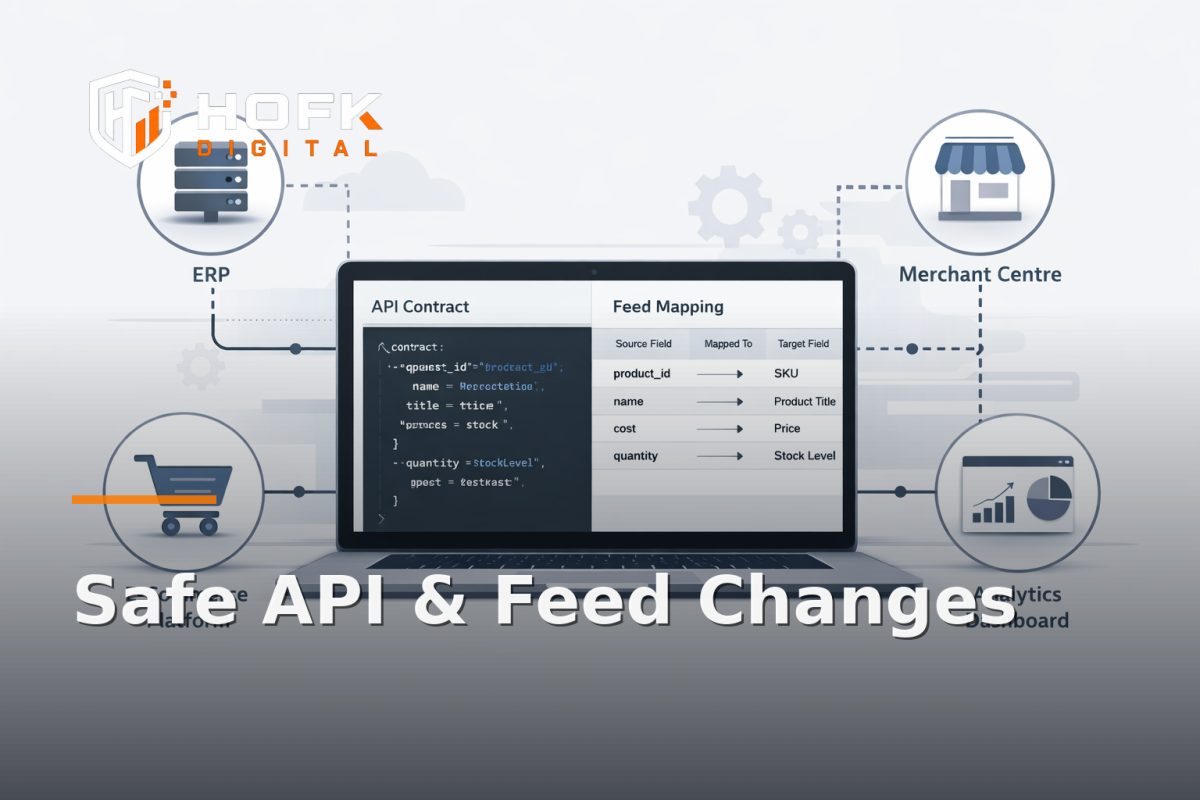
How to Manage API and Feed Version Changes Safely in Retained Ecommerce Development
When a supplier changes an API, or a feed contract starts returning a slightly different shape of data, the problem rarely appears as a dramatic outage. More often, it shows up quietly: a missing variant, a stale price, a broken stock flag, a checkout handoff that no longer matches the latest payload. That is why a good integration change-control process matters in retained ecommerce development. It is not about slowing work down. It is about making sure changes land safely across the systems that depend on them.
For ecommerce teams, developers and technical delivery leads, the tricky part is usually not the code change itself. It is the chain of connected systems around it: the ERP, PIM, ecommerce platform, marketplaces, Merchant Centre, fulfilment tools, analytics, and any custom middleware in between. One version bump can ripple through all of them. If the change is handled casually, you can end up with data drift, failed imports, rejected listings or support tickets that take days to trace.
This article focuses on one practical problem: how to introduce breaking API or feed changes safely when you are working in a retained support model. The goal is to make version changes predictable, visible and reversible.
Start by defining what is actually changing
The word “version change” can mean several different things. Before anyone updates code or swaps a feed endpoint, write down exactly what is changing and who it affects.
- Is the change in the source system, such as a supplier API?
- Is the change in the export format, such as a product feed or price feed?
- Is the change in the destination schema, such as a marketplace, ad platform or ecommerce platform?
- Is the change breaking, additive or just a field rename?
This matters because the response should match the risk. A new optional field is not the same as removing a required identifier. A format change to an internal sandbox is not the same as changing a live marketplace feed. If the team cannot describe the change in one sentence, the change is probably not ready for release.
Use the integration change-control process as a release filter
A practical integration change-control process should act like a simple release filter. It should answer five questions before anything goes live:
- What is changing?
- Which systems depend on it?
- What is the deprecation window?
- How will we test it in a sandbox?
- What is the rollback plan if something breaks?
If those answers are not documented, the change is still a risk, not yet a release. In retained ecommerce development, this is especially important because changes are often delivered alongside everyday support work. Without a clear gate, a “small” request can turn into an unplanned production dependency.
Build a dependency map before you touch production
Before a version change is approved, map every downstream system that consumes the integration. This is the part many teams skip, because the immediate problem looks local. In reality, the dependency map is where most of the risk lives.
Questions to include in the map
- Which systems read this feed or API response?
- Which fields are mandatory for each consumer?
- Which consumers tolerate missing values, and which do not?
- Which routes are human-reviewed, and which are fully automated?
- What reports, dashboards or campaign tools rely on the same data?
For example, a product feed may look fine to the ecommerce platform but still break Google Shopping because a required attribute has been renamed. A supplier API may still return a 200 response while silently dropping a variant field that your storefront logic expects. Dependency mapping is what helps you catch those problems early.
Set a deprecation window before the new version is used
One of the safest ways to manage API change control is to avoid hard cutovers where possible. A deprecation window gives consumers time to move from the old contract to the new one while both are still available.
A useful deprecation plan should state:
- when the old version will stop being supported
- when the new version becomes available
- which consumers are expected to migrate first
- what level of support remains for the old version during the transition
In retained development support, this is often more practical than trying to force every system onto a new version at once. The window gives you time to test, compare, and monitor rather than gambling on a single release moment. VERIFY: the length of the deprecation window should be agreed against the complexity of the systems involved, not chosen arbitrarily.
Test in a sandbox, but test like it is live
A sandbox only helps if it behaves enough like production to expose the real issues. Too many teams test whether the endpoint responds, then assume the integration is safe. That is not enough.
Good sandbox testing should cover:
- full payload shape, not just one or two fields
- boundary values, such as empty stock, sale price, long titles or missing variants
- error responses and timeouts
- authentication and retry behaviour
- how the system behaves when the schema changes unexpectedly
If your integration is feed-heavy, compare the sandbox output with a sample of live data. If your integration is API-driven, test the exact request and response structure that production will use. The point is to confirm that the new version can survive real ecommerce data, not just tidy demo records.
Define rollback criteria before the release
Rollback is easiest when the team agrees in advance what failure looks like. If you only decide after launch, people tend to debate whether the issue is “bad enough” to revert. That delay can be costly when feeds, checkout handoffs or marketplace listings are affected.
Your rollback criteria should be explicit. For example:
- required fields are missing from the live response
- more than one downstream system rejects the new payload
- pricing or stock data diverges from the source of truth
- the new version produces unexplained import errors
- a critical consumer cannot be updated within the deprecation window
Rollback should also be specific. Will you restore the previous feed file, switch the endpoint back, disable the middleware route, or pin the consumer to the prior version? If the answer is not obvious, the rollback plan is not ready.
Notify downstream stakeholders before, during and after the change
Integration changes are rarely just technical events. They affect ecommerce managers, marketing teams, operations, and sometimes suppliers or marketplace contacts. Good downstream stakeholder notifications are part of the safety process, not an optional courtesy.
Who needs to know
- ecommerce or trading leads
- operations or fulfilment owners
- marketing or paid media teams
- customer service or support teams
- any external partner that consumes the feed or API
Tell them what is changing, when the deprecation window begins, what to watch for, and who to contact if something looks wrong. If the change affects feeds used in campaigns or shopping channels, the marketing team should know whether any tracking, ranking or product visibility might shift. That keeps surprises out of live trading.
Use retained development support to keep the change small and visible
Retained development support is useful because it gives you continuity. The same team can see how a change sits alongside previous changes, which systems are sensitive, and where the history of issues lives. That matters more than it sounds.
In practice, retained support should make it easier to:
- review prior integration changes before making a new one
- spot consumers that still rely on older contracts
- keep a consistent test and rollback pattern
- avoid “one-off” fixes becoming permanent hidden dependencies
If your ecommerce stack includes custom APIs, feeds or operational software, continuity is often what keeps version changes manageable. It also makes it easier to keep API change control aligned with the real trading setup rather than a theoretical architecture diagram.
Document the contract as well as the code
One of the most common causes of feed and integration governance problems is contract drift. The code may be changed, but the documentation, sample payloads and support notes do not keep up. Then the next person inherits a system that appears to work but is hard to change safely.
For each live integration, keep a short contract record that includes:
- version number or revision date
- source and destination systems
- required fields and allowed values
- deprecation date for old versions
- test and rollback notes
- named owner
This does not need to be a huge document. It just needs to be current enough that another developer or operations lead can tell what the integration expects without guessing.
Watch for signs that the process is too loose
If version changes keep becoming urgent, the change-control process may be too informal. Common warning signs include:
- support tickets that repeat after every feed update
- different teams using different versions of the same contract
- no clear owner for deprecated endpoints
- tests that only happen after the change is already live
- rollbacks that depend on memory instead of a written procedure
Those are usually signs that the integration change-control process needs tightening, not that the developers are simply moving too slowly. A safe release process should reduce friction after the first few versions, not create more of it.
A practical sequence for safe version changes
If you need a repeatable method, use this sequence:
- Write the change summary in plain English.
- Map every downstream consumer.
- Set the deprecation window and support period.
- Test the new version in a sandbox with live-like data.
- Define rollback criteria and the rollback route.
- Notify stakeholders before the release.
- Monitor live consumers after launch.
- Retire the old version only after confirmation.
This sequence is deliberately boring. That is a good thing. Safe API and feed versioning works best when the process is clear enough that people can follow it under pressure.
Where HOFK fits
HOFK works across ecommerce support, full stack development, website monitoring, automation and operational workflows. In projects like this, the useful work is often not just writing the code for the new version. It is making the integration easier to test, easier to monitor and easier to revert if needed.
That may include feed and integration governance, endpoint versioning, test harnesses, release notes, stakeholder communication or the practical work of tracing which systems still rely on the old contract. For businesses that keep ecommerce stable through retained development support, that operational detail matters because version changes rarely stay local.
Conclusion
If you want to manage API and feed version changes safely, do not rely on hope or informal handovers. Treat the change as a controlled release: define the version difference, map the dependencies, test in a sandbox, set rollback criteria, and notify the people who rely on the data. That is the practical side of an integration change-control process in retained ecommerce development.
When API change control and feed and integration governance are handled well, version updates become easier to plan and less likely to disrupt trading. If your ecommerce stack needs help making those changes safer, HOFK can support with retained development support, full stack development and the implementation detail behind connected systems that need to keep working together.
Target keyword: integration change-control process
Related terms: API change control, feed and integration governance, retained development support
Frequently Asked Questions
What is an integration change-control process?
It is a structured way to review, test, approve and roll back changes to APIs, feeds and connected systems so version updates do not break ecommerce operations.
Why are deprecation windows important?
They give downstream systems time to move from an old contract to a new one without forcing a hard cutover. That reduces the chance of breakage during release.
What should be tested in a sandbox?
Test the full payload shape, boundary cases, errors, authentication, retries and how the system behaves when fields are missing or renamed. The sandbox should feel as close to live as possible.
When should rollback be triggered?
Rollback should be triggered if required fields are missing, critical consumers reject the new payload, pricing or stock diverge, or the new version causes unexplained errors.
Who should be told about an API or feed change?
Ecommerce leads, operations, marketing, support and any external partner that consumes the integration should be notified before and after the change.