
How to Trace the Root Cause of GA4, CRM and Order Mismatches by Handoff Layer
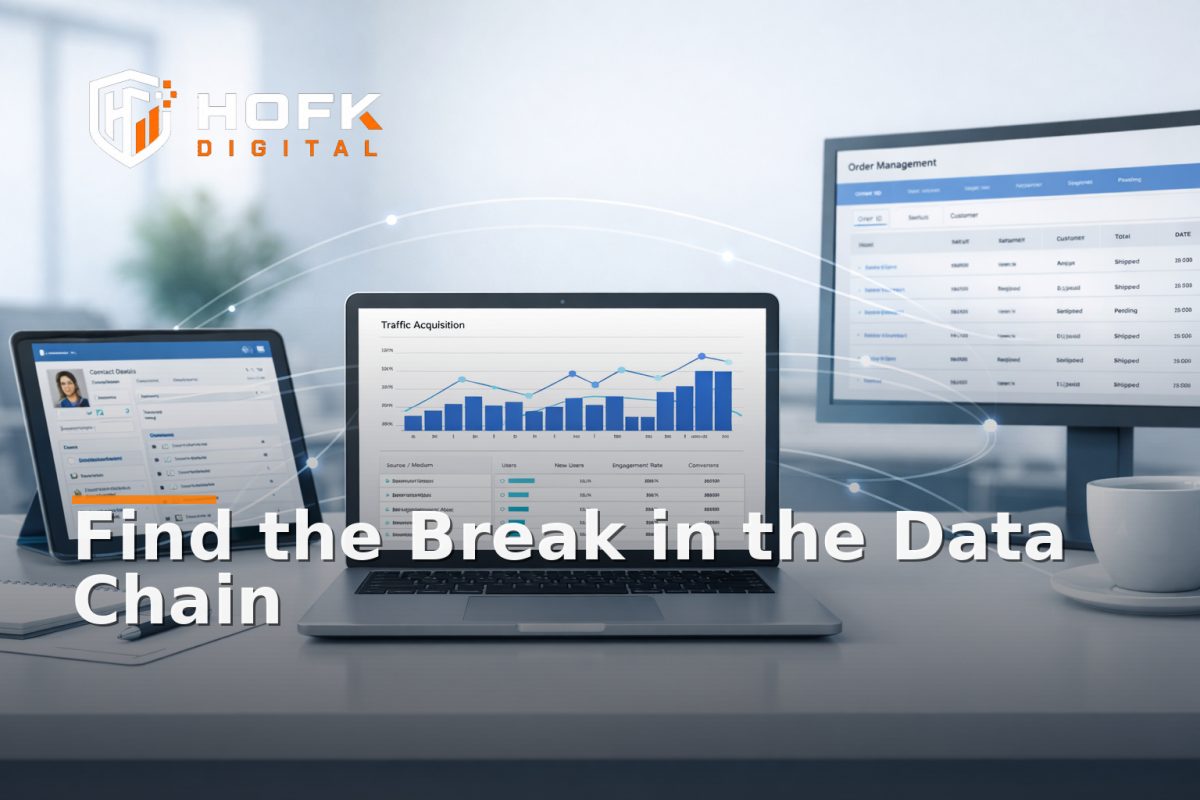
If your orders look right in the ecommerce platform but GA4 and the CRM tell a different story, do not start by blaming the dashboard. The faster way to solve GA4 reporting discrepancies is to trace where the data first changes shape.
In most stores, the mismatch is not one big error. It is a handoff problem. The break may happen when consent is set, when identity is carried across the session, when the CRM receives the lead or order, or when the order sync writes back to the source of truth. If you do not isolate that layer first, you can spend days adjusting reports while the underlying problem stays put.
This guide is for ecommerce managers, merchandisers, operations leads and marketing teams who need to reconcile GA4, CRM and order records properly. The goal is not a general GA4 dashboard audit. It is a practical procedure for proving where the mismatch begins.
Start with one question: where does the truth first diverge?
Before changing tags, fields or reports, pick one real order or lead and ask a simple question: at what point do the numbers stop agreeing?
A useful sequence is:
- What does the user see on the site?
- What does GA4 record?
- What does the CRM store?
- What does the order system or ERP show?
If those four records do not match, the job is to find the first layer where they split. That first split usually tells you where the fix belongs.
Use a handoff-layer model, not a channel-by-channel guess
The most useful way to investigate a CRM and analytics mismatch is to think in handoff layers. Each layer has a job, and each layer can fail independently.
1. Consent layer
This is where tracking permission is granted, denied or delayed. If consent mode is not implemented cleanly, GA4 may collect less data than the CRM or order system. That can make conversion volumes look low even when sales are healthy.
Check whether:
- consent is captured before key events fire
- tags behave differently when consent is refused
- mobile consent banners delay or suppress tracking
- the same consent state is applied consistently across page types
If consent is the first point of failure, the mismatch is probably a measurement issue rather than a commercial one.
2. Identity layer
Identity is how the system knows the same person or order is the same journey across browser, CRM and backend records. If the identifier is lost or overwritten, reports will drift.
Look for:
- click IDs that disappear after redirects
- session IDs that reset on checkout or form submission
- duplicate user records in the CRM
- order references that are not carried through cleanly
This is often where a ecommerce reporting discrepancy starts: the sale is real, but the join between systems is weak.
3. CRM mapping layer
The CRM may be receiving the lead or order correctly, but mapping it to the wrong campaign, source or status. That creates a mismatch even when GA4 did its job.
Check whether:
- source and medium fields are mapped to the correct CRM properties
- lead status rules are changing the record after creation
- duplicate suppression is hiding valid entries
- sales or ops users are overwriting campaign data manually
When this layer is wrong, GA4 may be accurate and the CRM may still look misleading. The issue is not reporting volume; it is record handling.
4. Order-sync layer
This is the handoff from checkout or order capture into the backend system of record. If the order sync is delayed, partial or overwritten, GA4 and CRM can both look out of step with the actual order state.
Review:
- whether the order reference is identical in each system
- whether the payment state matches the final order state
- whether refunds or amendments are written back correctly
- whether the sync runs once or creates duplicate records
For teams using a custom stack, this is often where full stack development support becomes useful, because the break is in the data handoff rather than in the report itself.
Build a simple reconciliation sequence
To diagnose GA4 reporting discrepancies properly, use the same order or lead through the same four-step comparison every time.
- Start with the live journey — capture what the user did, including the page, product, form or checkout step.
- Check GA4 — confirm what event fired, when it fired and what parameters were attached.
- Check the CRM — compare the record created, source attribution, status and timestamps.
- Check the order system — confirm the order, payment or fulfilment record matches the same identity.
Do not compare totals only. Compare identifiers, timestamps, source values and status values as well. Totals can sometimes look close enough to hide the real issue.
What to record for each test case
When you are tracing a mismatch, keep the evidence structured. A simple audit sheet is usually enough.
- Test date and time
- Test order, lead or basket reference
- Device and browser
- Consent choice
- Landing page or entry route
- GA4 event name and key parameters
- CRM record ID and mapped source values
- Order ID or backend reference
- Point where the records first diverged
This record is especially useful if more than one team is involved. It stops the problem becoming a vague debate about whose system is right.
How to tell where the break started
Each handoff layer tends to leave a different clue.
If the break starts in consent mode
GA4 will usually show reduced or partial data, especially on mobile or in sessions where consent is delayed. The CRM or order system may still record the conversion normally. In that case, the issue is likely measurement configuration, not sales performance.
If the break starts in identity persistence
You may see the right order, but the wrong source or campaign attached to it. The record exists, but the join between the visitor and the final order is weak. This is common after redirects, cross-domain checkout or session resets.
If the break starts in CRM mapping
GA4 may look fine, but the CRM shows the wrong source, channel or owner. This can happen when field mapping is out of date, when manual edits overwrite the original source, or when lead status rules change after creation.
If the break starts in order sync
GA4 and CRM may both show a conversion, but the backend order is delayed, duplicated or missing a status change. That usually means the handoff into the order system needs review, especially where payment, fulfilment or refund logic is involved.
Do not overuse a GA4 dashboard audit if the real issue is upstream
A GA4 dashboard audit can be useful for presentation and reporting layout, but it will not fix a bad handoff. If the source records are wrong, the dashboard is just displaying the problem cleanly.
That is why the best next step is usually not a new chart or a new report tab. It is to verify the handoff layer where the mismatch first appears. Once that layer is fixed, the reporting becomes much easier to trust.
A practical decision tree
Use this simple order when troubleshooting:
- Is the user journey complete? If not, the issue may be in the page, form or checkout flow.
- Did GA4 capture the event correctly? If no, look at consent, tag firing and identity persistence.
- Did the CRM receive the right record? If no, review mapping, deduplication and status rules.
- Did the order system write the same truth? If no, inspect order-sync logic and backend handoff.
That sequence helps you separate tracking loss from backend drift. It also stops teams from changing three systems when only one is actually broken.
What HOFK usually checks in this kind of project
HOFK works with ecommerce teams, marketers and operators who need practical visibility across GA4, CRM and order data. In a reconciliation review, the useful work is often not just looking at the report. It is checking the implementation path that feeds it.
That can include:
- tag governance and event structure
- consent behaviour and tracking order
- cross-domain or cross-system identity handling
- CRM field mapping and status logic
- order sync timing and backend write-back rules
For businesses using custom builds or connected operational software, the problem is often in the handoff, not the chart. HOFK’s analytics and attribution work is most useful when it helps trace that handoff clearly and make the reporting chain easier to maintain.
Checklist: proving where GA4, CRM and orders disagree
- Pick one real order or lead
- Record the live user journey
- Check the GA4 event and parameters
- Check the CRM record and mapped source fields
- Check the order or backend reference
- Find the first layer where the values diverge
- Fix that layer before touching the others
Conclusion
If your numbers do not line up, the quickest way to solve GA4 reporting discrepancies is to trace the handoff layer by layer. Start with consent mode, then identity persistence, then CRM mapping, then order sync logic. That gives you a clear way to prove whether the mismatch is caused by tracking loss, record handling or backend handoff.
For ecommerce managers and operational teams, that distinction matters. A true CRM and analytics mismatch needs a different fix from a backend order issue, and a real ecommerce reporting discrepancy is much easier to solve when you know where it started. If you need support tracing that path, HOFK can help with analytics and attribution, full stack development, and the implementation detail behind cleaner reporting workflows.
VERIFY: exact consent behaviour, CRM mapping rules and order-sync logic will vary by platform, tag setup and backend architecture.
Frequently asked questions
What are GA4 reporting discrepancies?
They are mismatches between what GA4 records and what the CRM or order system shows. The break can happen in consent, identity handling, CRM mapping or order sync logic.
What is the fastest way to find a CRM and analytics mismatch?
Take one real order or lead and compare the live journey, the GA4 event, the CRM record and the backend order. The first place they stop matching is usually the layer that needs fixing.
Why should I not start with the dashboard?
Because a dashboard only presents the data it receives. If the source records are wrong, the dashboard will not show you where the problem began.
Can consent mode cause ecommerce reporting discrepancy?
Yes. If consent is delayed, refused or implemented inconsistently, GA4 may record less data than the CRM or order system.
When should a developer get involved?
If the mismatch appears in identity persistence, order sync, cross-domain handoff or backend write-back logic, it usually needs technical review rather than only reporting changes.