

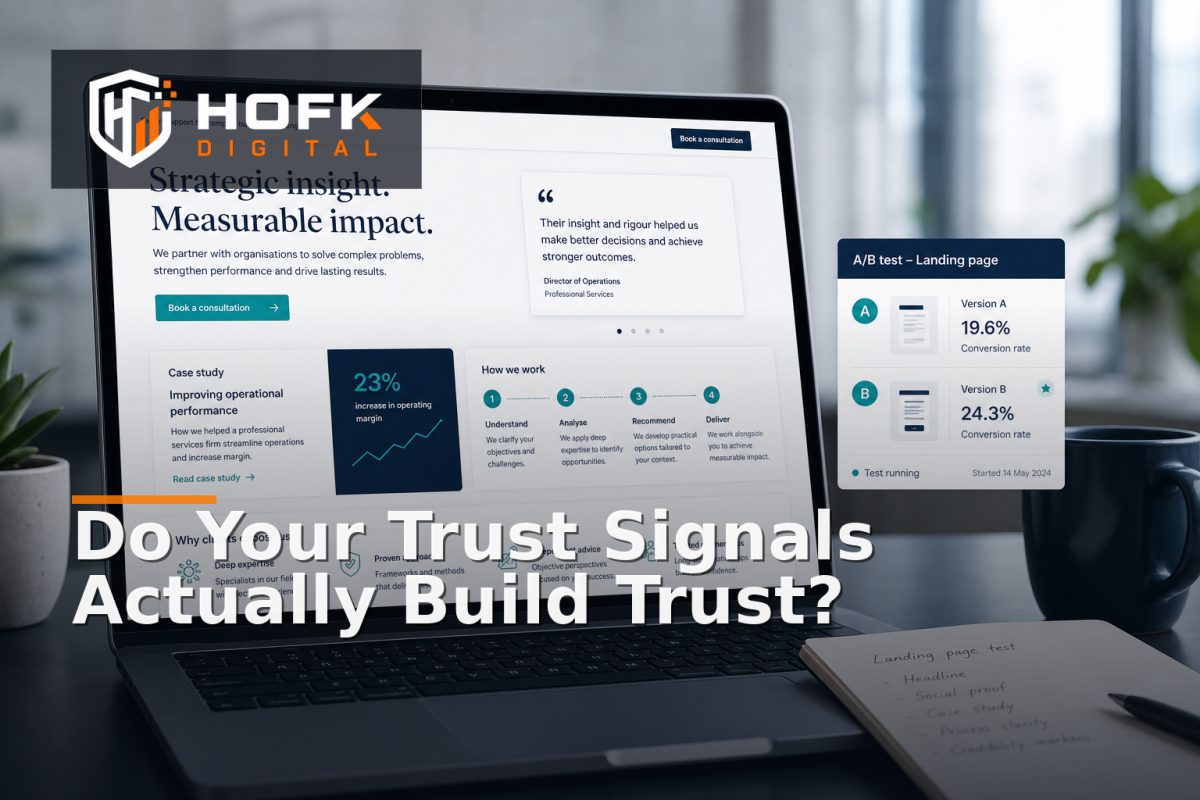
How to Test Trust Signals on High-Value Service Landing Pages
A visitor considering a £20 purchase may decide quickly. A buyer considering a £20,000 service usually needs more reassurance. They may want to know whether your team understands their situation, whether the work will be delivered reliably and whether choosing you will create internal or commercial risk.
That is why service landing page trust signals deserve more than a decorative review strip or a row of familiar logos. On a high-value B2B page, proof should help the visitor answer practical questions: have you done this kind of work before, can I understand what happens next, and will I be able to justify this choice to other decision-makers?
This guide explains how to test trust signals on considered-service landing pages. It focuses on landing page credibility, lead generation CRO and service website conversion testing without assuming that the highest conversion rate automatically represents the best outcome.
Why trust signals need testing rather than decoration
Trust content is often added by instinct. A team places testimonials below the hero, adds a certification badge or includes a client logo because it feels reassuring. Those elements may help, but their effect depends on context.
A testimonial from an unrelated sector may be less persuasive than a short comment from a similar business. A logo wall may create recognition but provide no evidence of what was delivered. A long process section may reassure one buyer while overwhelming another.
Testing helps you understand which proof reduces uncertainty for the audience you actually want. It also prevents the page becoming crowded with claims that sound credible internally but do not answer the visitor’s real concerns.
Define the buying risk before choosing the proof
The right trust signal depends on the risk the buyer is trying to manage. Start by listing the doubts that could delay an enquiry.
- Capability risk: can the provider handle the technical, operational or strategic problem?
- Delivery risk: will the work be completed properly and within a workable timeframe?
- Commercial risk: will the investment produce a useful outcome?
- Internal risk: can the buyer defend the decision to colleagues, directors or procurement?
- Fit risk: does the provider understand this sector, business model or level of complexity?
For example, a B2B ecommerce team may need evidence of integration and data-handling experience. A founder buying a website project may care more about clarity, responsiveness and the ability to work without unnecessary management overhead.
Do not test a trust signal until you know which concern it is intended to address.
Classify service landing page trust signals by job
Trust signals become easier to test when each one has a defined purpose. A practical framework includes five groups.
1. Relevant experience
This can include sector experience, platform knowledge, project types or familiarity with a particular operational problem. Keep it specific. Saying that a team has experience across digital projects is less useful than explaining the type of problem it can help solve.
2. Outcome-based proof
Case studies, testimonials and project summaries should explain what changed, not only that the client was satisfied. Useful proof may describe a clearer workflow, a more reliable data handoff, improved visibility or reduced manual effort. Avoid inventing figures or implying results that cannot be evidenced.
3. Process transparency
High-value buyers often want to understand what happens after they enquire. A clear discovery, audit, planning or delivery process can reduce uncertainty without making an unsupported performance claim.
4. External validation
Accreditations, memberships, platform partnerships and recognised standards can support credibility when they are relevant and current. They should not be used as a substitute for explaining how the service solves the buyer’s problem.
5. Risk-reducing information
This includes clear scope boundaries, realistic next steps, support arrangements, technical ownership and what the first conversation will cover. For considered services, clarity can be more reassuring than a large number of badges.
Match each signal to the point of hesitation
Trust signals are more useful when they appear close to the question they answer. Do not assume every proof point belongs in the hero section.
A visitor who is still deciding whether the page is relevant may need a concise statement of expertise near the top. Someone comparing providers may need a relevant case study or explanation of your working process. Someone ready to enquire may need reassurance about what happens after submitting the form.
Create a simple journey map:
- Recognition: does the visitor understand that the page is relevant to their problem?
- Evaluation: can they see evidence that the provider is capable and suitable?
- Risk review: can they understand the process, scope and likely next step?
- Action: do they know what will happen after making contact?
This prevents a common mistake in lead generation CRO: placing every trust element above the fold, where it competes with the main message and call to action.
Choose one trust question to test at a time
Testing becomes difficult when a page changes its testimonial, headline, CTA, form length and process section simultaneously. If performance changes, you will not know which decision caused it.
Instead, write a hypothesis in this format:
Because [audience concern], showing [specific proof] near [page section] should improve [measurable behaviour] without reducing [lead-quality measure].
For example: because operations leaders are concerned about implementation disruption, showing a short delivery-process summary beside the enquiry CTA should increase qualified form starts without increasing unsuitable submissions.
The hypothesis is more useful than a vague goal such as make the page feel more trustworthy.
Build test variants around proof, not visual novelty
A service website conversion testing programme does not need dramatic redesigns. The most useful variants often change the type, wording or position of proof while keeping the rest of the page stable.
You could compare:
- a sector-specific testimonial against a general testimonial;
- a client logo against a short outcome-based case summary;
- a process explanation near the form against the same explanation lower on the page;
- a founder or technical lead introduction against an anonymous team statement;
- a concise proof point against a longer list of accreditations or capabilities.
Keep the variants honest. Do not remove useful qualification or make a claim more specific than the evidence supports simply to create a stronger test.
Measure more than the form conversion rate
A trust signal can increase submissions while reducing lead quality. It can also reduce raw conversion rate while improving the proportion of enquiries that are commercially useful. That is why conversion rate alone is a weak decision metric for high-value services.
Track a wider set of measures:
- landing page engagement with the proof section;
- CTA clicks and form starts;
- completed enquiries;
- use of phone, email or alternative contact routes;
- lead qualification against agreed criteria;
- booked discovery calls or sales conversations;
- sales acceptance, progression or disqualification reasons;
- time from enquiry to a meaningful next step.
Where possible, connect the landing page event to CRM or sales records. If that is not yet available, use a practical review sample and record the quality of enquiries manually. VERIFY: the right lead-quality definition and CRM fields will depend on the organisation’s sales process.
Use qualitative feedback to explain the result
Analytics can tell you that one version produced more form starts. It cannot always tell you why. A small amount of structured qualitative feedback can make the result much easier to interpret.
Ask recent prospects or internal sales colleagues:
- What made the page feel relevant or irrelevant?
- What information was missing before they felt comfortable enquiring?
- Which proof point did they notice first?
- Was any claim unclear, exaggerated or difficult to verify?
- What would they need to explain the choice to another decision-maker?
Keep the questions neutral. Do not ask whether a testimonial was persuasive if you have already told the participant that it should be.
Check credibility before increasing prominence
A trust signal can become less credible when it is made more prominent without improving its substance. Before moving proof into the hero section, check whether it is:
- specific enough to understand;
- relevant to the target buyer;
- current and accurate;
- clear about what was actually delivered;
- supported by permission where a client name or logo is used.
Be particularly careful with vague superlatives such as best, leading or trusted unless they are genuinely supported. Landing page credibility is usually strengthened by concrete detail, not by increasing the volume of praise.
Test trust signals by audience and service type
High-value service pages often serve more than one audience. A founder, marketing manager and operations lead may arrive through different routes and assess risk differently.
If the page receives enough traffic, segment results by meaningful context such as campaign, service type, device, company size or known audience group. If the sample is too small for reliable statistical comparison, use the segments as a qualitative review framework rather than presenting weak differences as definitive.
A technical implementation page may need proof of systems experience. A responsive website page may need evidence of mobile thinking and maintainable delivery. An SEO or Google Ads page may need clearer measurement and optimisation context. The trust signal should fit the service being considered.
Set a decision rule before the test runs
Agree in advance what would justify keeping, changing or rejecting a trust-signal variant. This helps prevent the team selecting a result because it confirms an existing preference.
A practical decision rule might include:
- keep the variant only if qualified enquiries do not fall;
- treat a small conversion-rate difference as inconclusive if the sample is limited;
- review lead-quality comments before declaring a winner;
- check whether the result is consistent across mobile and desktop;
- document any trade-off between enquiry volume and commercial fit.
Do not claim statistical certainty unless the test design and sample support it. For many B2B service pages, a staged test and a structured review may be more realistic than a high-volume experiment.
What to do when traffic is limited
High-value service pages may not receive enough traffic for traditional A/B testing. That does not mean testing is impossible. Use a sequence of smaller checks:
- audit the existing page against the buying risks;
- interview sales or recent prospects about missing reassurance;
- make one clearly documented trust-signal change;
- monitor qualified actions and enquiry quality over an agreed period;
- review the evidence before making another change.
This approach is slower than declaring a winner after a handful of form submissions, but it is more defensible. It also helps build a clearer understanding of the audience before more traffic or budget is committed.
A practical service landing page trust signals checklist
- Have we defined the buyer’s main perceived risks?
- Does each trust signal answer a specific concern?
- Is the proof relevant to the service and audience?
- Are claims specific, accurate and current?
- Have we tested placement as well as wording?
- Are we measuring qualified outcomes, not only form volume?
- Can sales explain whether lead quality changed?
- Have we agreed a decision rule before reviewing results?
- Is the page still clear on mobile?
- Have we documented what was changed and why?
Where HOFK can help
Trust testing sits between content, analytics, responsive implementation and commercial workflow. HOFK can support businesses with responsive landing pages, SEO and Google Ads, full stack development and practical conversion-focused improvements.
The useful work may involve clarifying the page’s audience, structuring proof sections, improving form and CRM handoffs, adding measurement, or making the page easier to update without introducing inconsistent states. HOFK’s SEO & Adwords support is relevant where paid traffic and landing-page intent need to work together, while full stack development can help when the testing problem sits in the template, data layer or enquiry workflow.
Conclusion
Effective service landing page trust signals do more than make a page look established. They reduce a specific buying concern and help a considered B2B buyer understand why your service is credible, relevant and manageable.
Define the risk, match proof to the hesitation, test one meaningful change at a time and measure qualified outcomes alongside conversion rate. Then use sales feedback and structured review to understand what the data is actually saying. That is a more reliable route to landing page credibility than adding more logos, badges or generic testimonials.
For high-value service pages, the goal is not maximum form volume at any cost. It is a clearer path to the right conversation.
Frequently asked questions
What are service landing page trust signals?
They are evidence or information that reduces uncertainty on a service page, such as relevant experience, case studies, testimonials, process detail, credentials and clear next steps.
How should I test trust signals on a B2B service page?
Define the buyer’s main concern, create a specific hypothesis, change one proof element or placement at a time, and measure qualified enquiries as well as conversion rate.
Which trust signals work best for high-value services?
The most useful signal depends on the perceived risk. Relevant case evidence, clear delivery process, sector experience and specific outcomes are often more useful than generic logos or broad claims.
Should trust signals be placed above the fold?
Not always. Put each signal close to the question it answers. A concise relevance cue may belong near the top, while process detail or a case study may work better near the enquiry decision.
What if the landing page does not receive enough traffic for A/B testing?
Use smaller staged tests, prospect or sales interviews, structured lead-quality reviews and documented before-and-after comparisons. Avoid presenting a small sample as statistically conclusive.