

How to Run a Monthly Release Sign-Off for Retained Ecommerce Development Teams
When you work with a retained ecommerce development team, the monthly release should not be treated like a quick tidy-up at the end of the month. It is a governance point. The whole value of a retained model is that the ecommerce manager and the development partner can keep improving the site in smaller, safer steps. That only works if each release has a clear sign-off process, clear ownership and evidence that repeat defects are not being allowed back in.
If your current monthly release readiness checklist is just a list of tasks, it is probably not doing enough. A better approach is to turn it into a release governance framework: who reviews what, what must be signed off before deployment, what evidence is required, and what gets carried forward into the next release if something failed this time.
This article is for UK ecommerce managers, founders, operations leads and product owners who depend on a retained development partner for scheduled deployments. The aim is practical: reduce repeat release mistakes, keep accountability clear, and make each monthly release easier to trust.
Why a retained model needs release governance, not just a checklist
A retained partner arrangement changes how releases should be managed. You are not hiring someone to fix one isolated project. You are building an ongoing relationship where improvements, bug fixes, technical debt and commercial priorities all compete for space in the same release window.
That means the release process needs three things:
- Ownership – the ecommerce manager knows what is business-critical, and the retained development team knows what is technically risky.
- Evidence – the team can show what was tested, what passed, what failed, and what changed.
- Continuity – repeat defects are tracked across releases so the same issues do not keep reappearing under new labels.
A monthly release readiness checklist is still useful, but only when it sits inside that wider governance structure. Otherwise, it becomes a memory aid rather than a release control.
Define ownership before the release is even scheduled
The first decision is not what to test. It is who owns the release.
In a retained ecommerce development setup, there should usually be two named owners for every monthly deployment:
- Ecommerce manager owner – accountable for commercial priority, customer impact and sign-off on business-ready changes.
- Retained development owner – accountable for build quality, technical risk, deployment sequencing and rollback readiness.
Those two roles should not overlap by default. If one person is both the business approver and the technical checker, the release can become too informal. The value of retained ecommerce development is that the business and technical sides can challenge each other before something goes live.
A useful rule is this: the ecommerce manager decides whether the release is acceptable commercially; the retained development team decides whether the release is acceptable technically. If either side is unsure, the release should not be treated as ready.
Practical ownership split
- The ecommerce manager confirms the commercial scope, priority order and acceptable exceptions.
- The development team confirms technical dependencies, deployment sequence, test coverage and rollback steps.
- The operations lead or other stakeholder confirms any fulfilment, stock, pricing or customer-service dependencies that the release may affect.
If those names are not written down, the monthly process will drift back into assumptions.
Use a sign-off pack, not a loose task list
A strong release process works better when every monthly deployment uses the same sign-off pack. That pack should make it obvious what is changing, who approved it and what evidence supports the decision.
At minimum, the pack should include:
- Release date and version
- Summary of changes
- Known dependencies
- Named owners
- Testing evidence
- Open issues and exceptions
- Rollback plan
- Final sign-off decision
This is where a deployment readiness checklist becomes useful. It should not only say what needs checking. It should also record what was checked, by whom, and where the evidence lives.
If your retained partner is already using backlog tickets, bug tickets or release notes, the sign-off pack should point to those references rather than duplicating everything. The goal is to create one release record that can be reviewed later.
What must be signed off before each monthly release
Every monthly release should have a small set of non-negotiable sign-off areas. These are the areas most likely to create repeat defects if they are not controlled properly.
1. Scope and commercial priority
The ecommerce manager should confirm exactly what is going live. This avoids the common problem where a release includes a few extra fixes or content changes that were added late and never fully reviewed.
Ask:
- What is in the release?
- What is explicitly out of scope?
- Which item is the commercial priority?
- Which known issues are being deferred?
2. Technical dependencies
The retained development team should confirm whether the release touches any connected systems, theme logic, APIs, feeds, payment flows, or third-party integrations. If a change affects several moving parts, the sign-off should say so clearly.
Where a release depends on ERP data, Merchant Centre feeds, or other connected workflows, verify timing and ownership carefully. If the integration chain is not stable, the deployment may be technically complete but commercially risky. VERIFY: exact handoff behaviour will vary by platform and integration setup.
3. Testing evidence
Do not sign off on confidence alone. Ask for evidence that the right journey was tested. That might be screenshots, screen recordings, logs, ticket references, or a short written note showing what was verified.
Useful evidence usually covers:
- Desktop and mobile checks
- Any high-risk journey or page
- Known failure cases, not just happy-path tests
- Evidence that the change was tested in the right environment
4. Rollback readiness
Every release should have a rollback plan before it is approved. If the deployment goes wrong, the retained development team should know how to reverse or pause the change quickly.
Rollback evidence should include:
- What would trigger rollback
- Who can call it
- How long rollback would take
- What systems or templates would be restored
5. Monitoring and post-release ownership
The release is not finished when it goes live. Someone must be watching for the first signs of trouble, especially if the change touches checkout, basket, forms, feeds or customer-facing templates.
In a retained ecommerce development process, the sign-off should say who owns the first-hour checks, the same-day review and the follow-up actions if something drifts.
Capture evidence in a way that reduces repeat defects
The biggest weakness in many release processes is not the deployment itself. It is the lack of useful evidence. If a defect returns in a later release, you need to know whether it was actually fixed, only masked, or never fully understood in the first place.
That is where repeat-defect control becomes important. A retained team should not just close a ticket and move on. It should capture enough detail to stop the same issue reappearing under a different label.
What good evidence looks like
- Issue description – what was wrong, in plain English
- Reproduction steps – how the issue was triggered
- Environment – where it was tested
- Fix summary – what changed
- Verification – what proved it worked
- Owner – who closed it
- Reference – ticket, log, or release note ID
If those details are captured consistently, the next monthly release can check whether the same failure pattern is returning. That is much more valuable than relying on memory.
Use a repeat-defect label
One practical habit is to add a repeat-defect label to the backlog whenever the same issue appears twice. For example, if a basket issue, a pricing mismatch, or a mobile rendering fault comes back in more than one release, it should be marked as recurring rather than treated like a new one-off bug.
That helps the retained development team prioritise properly. It also stops the ecommerce manager from assuming a problem was fixed when it was only partially solved.
Build the sign-off around common release failure points
Your monthly release readiness checklist should be shaped by the failures that actually cost time and confidence. For most ecommerce teams, the repeat problems tend to be fairly consistent.
Typical areas to review every month
- Basket and checkout – do key steps still work as expected?
- Responsive behaviour – does the change behave on mobile as intended?
- Forms and validation – do error states, inputs and handoffs still work?
- Feeds and integrations – does the data moving between systems still line up?
- Search and category logic – are products still surfaced properly?
- Monitoring and alerts – will we know quickly if the release causes a problem?
The point is not to inflate the checklist. The point is to focus the sign-off on the areas most likely to create repeat defects. If the same types of issue keep returning, they should become standing sign-off items, not afterthoughts.
Separate pre-release checks from release-day sign-off
One common mistake is to mix testing, approval and deployment into one blurred activity. In a retained model, those should be separate.
Use three distinct steps:
- Pre-release checks – the retained development team confirms the build is ready for review.
- Sign-off review – the ecommerce manager and any other stakeholder confirm scope, evidence and risk.
- Release-day deployment – the approved change is deployed under agreed conditions.
That separation matters because it creates accountability. If something fails, you can see whether the issue was in the build, the review or the deployment. Without that, the same defect can keep reappearing because nobody knows where it first slipped through.
Use the release meeting to stop the same issues returning
A monthly release meeting should not be a status update only. It should be a control point. The retained development team and ecommerce manager should look at the same short list of questions each time:
- What changed since the last release?
- Which defects repeated?
- Which fixes were verified properly?
- Which items were deferred and why?
- What should be added to the sign-off pack next month?
This is how a retained arrangement becomes more valuable over time. The team is not just shipping work. It is learning which defects keep coming back, which checks are insufficient, and where the release process needs tighter control.
What to do when a release fails sign-off
A failed sign-off should be useful, not awkward. If the release does not meet the standard, the answer should be clear: fix it, retest it, or defer it.
Use a simple decision rule:
- Fix now – the issue is release-blocking and the team can resolve it quickly.
- Retest – the issue needs another verification pass before approval.
- Defer – the issue is non-blocking and should be tracked as a future fix with an owner.
That approach keeps the monthly cadence moving without pretending every issue is equally urgent. It also makes the retained development team and ecommerce manager work from the same release language.
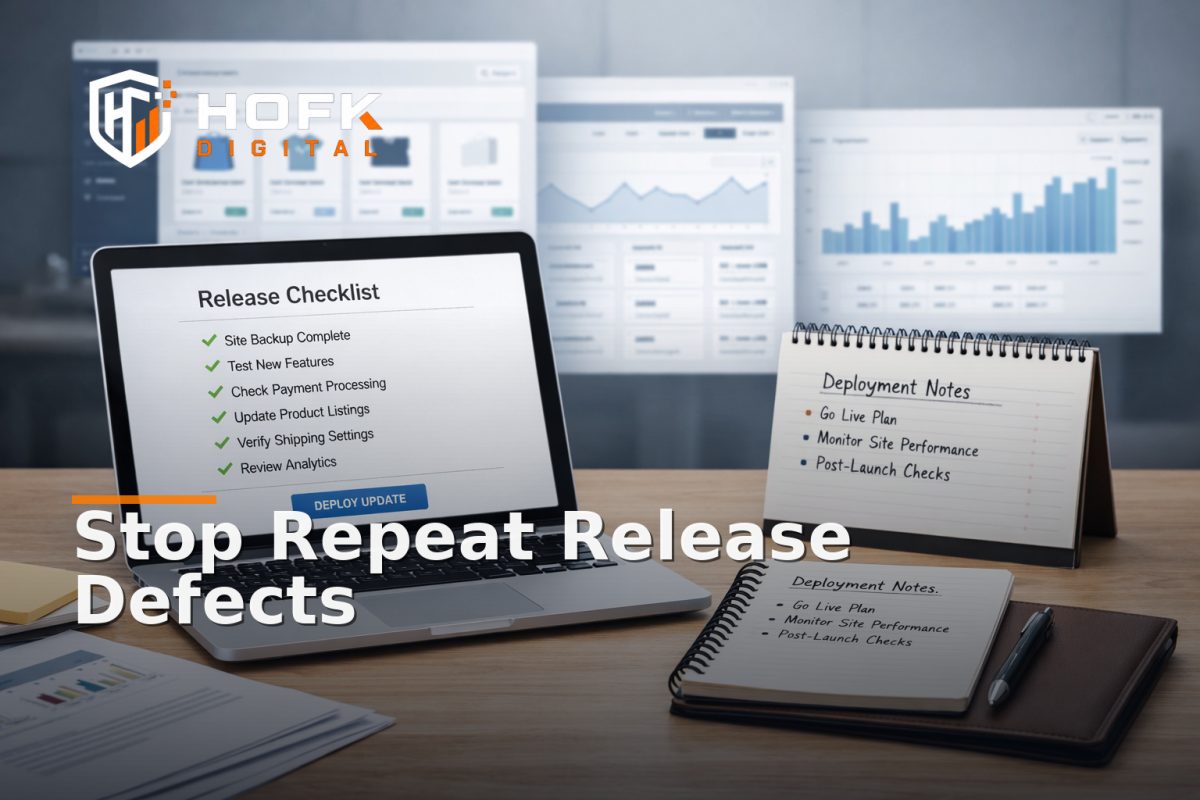
A practical monthly release sign-off checklist
If you want a clean starting point, use this checklist for every scheduled deployment:
- Release scope is confirmed and documented
- Commercial priority is clear
- Technical dependencies are understood
- Testing evidence is captured
- Repeat defects are checked against the backlog
- Rollback plan is written and accessible
- Monitoring owner is named
- Final sign-off is recorded by the right people
That is the core of a useful deployment readiness checklist for retained ecommerce development. It should be short enough to use every month, but strict enough to stop releases that are not ready.
How HOFK fits
HOFK works with ecommerce teams that need ongoing development support, practical release planning and the technical detail behind connected systems. In a retained model, the useful work is often not simply writing code. It is helping the team define what good looks like before each release, making the release evidence easier to trust, and reducing the chance of repeat defects coming back in the next cycle.
That can sit alongside full stack development, ecommerce support, monitoring, automation and operational workflow work. The aim is to keep the monthly release process commercially sensible and technically credible, not overcomplicated.
Conclusion
If you rely on a retained ecommerce development team, the monthly release should be governed, not improvised. A strong monthly release readiness checklist is useful, but it works best when it sits inside a clear sign-off framework with named ownership, evidence capture and repeat-defect control.
The practical goal is simple: the ecommerce manager and the retained development team should know who approves what, what evidence must exist before release, and how to stop the same defects returning month after month. That is how scheduled deployments become more predictable, more accountable and easier to improve over time.
If your release process needs a clearer structure, HOFK can help with ecommerce support, full stack development and the implementation detail behind more reliable retained development workflows.
Suggested next step: pick the last monthly release, list every defect that repeated, and add one sign-off check that would have caught each one earlier.
VERIFY: exact release windows, testing depth and approval steps will vary by platform, stack and retained support arrangement.
Frequently Asked Questions
What is a monthly release readiness checklist for retained ecommerce development?
It is a structured set of checks used before a scheduled deployment to confirm the release is commercially and technically ready. In a retained model, it should also show who owns each approval.
Who should sign off a monthly ecommerce release?
Usually the ecommerce manager signs off the commercial scope, while the retained development team signs off the technical readiness. Other stakeholders may need to review if the release affects operations, stock, pricing or fulfilment.
What evidence should be captured before a release goes live?
Capture the scope, test evidence, known exceptions, rollback plan and final approval decision. Screenshots, screen recordings, logs or ticket references are all useful where relevant.
How do you stop repeat defects from returning?
Track recurring issues separately, label them as repeat defects, and carry their history into the next release review. That makes it easier to see whether a fix was complete or only partial.
What is the difference between a checklist and release governance?
A checklist lists tasks. Governance defines ownership, evidence, approval rules and what happens when a release fails sign-off. For retained ecommerce development teams, governance is the more useful framework.