

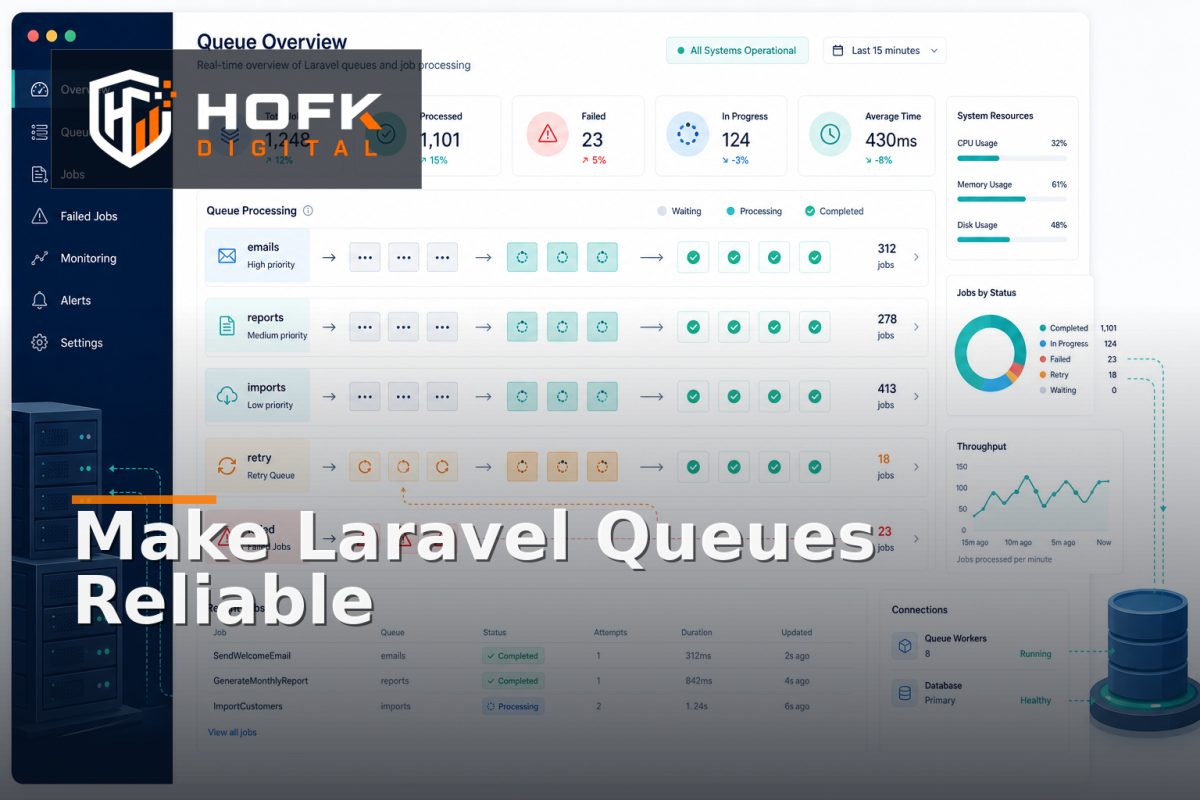
How to Make Laravel Queue Jobs Reliable in Operational Web Applications
An order exception is added to a queue, but nobody sees it. A stock synchronisation job retries three times and creates duplicate updates. A notification appears to have succeeded even though the downstream system never received it.
These are not unusual problems in Laravel applications that support ecommerce, fulfilment, finance, customer service or internal operations. Queues are useful because they move slow or unreliable work away from the user request. However, they also introduce another layer of state that needs to be designed, tested and monitored.
Good Laravel queue reliability means more than setting up a worker. It means making jobs safe to retry, visible when they fail and understandable when something goes wrong. This guide explains the practical controls that help operational Laravel applications process background work consistently.
What Laravel queue reliability needs to prove
A reliable queue should help the business answer five questions:
- Was the job created for the correct record?
- Did it run successfully?
- If it failed, will it retry safely?
- Can the team see and investigate the failure?
- Can the operation recover without manually guessing what happened?
This applies to jobs such as sending order updates, synchronising stock, importing supplier data, generating documents, notifying a warehouse, processing refunds or updating an internal exception queue.
The queue does not need to guarantee that every external service is always available. It does need to make temporary failure recoverable and permanent failure visible.
Start with a job inventory and business impact
Before changing retry settings, list the jobs running in the application. For each job, record its purpose, trigger, data source, downstream systems and business impact.
A useful inventory might include:
- Order or payment reference.
- Customer, product or asset identifiers.
- External API or service called.
- Whether the job changes financial, stock or operational data.
- Expected processing time.
- Whether duplicate execution could cause harm.
- Owner for investigating failure.
Not every job deserves the same queue, timeout or alert threshold. A delayed marketing notification is different from a job that confirms an order, changes stock availability or sends information to fulfilment.
Design jobs to be safe when they run twice
One of the most important principles of Laravel queue reliability is idempotency. An idempotent job can be run again without creating an incorrect duplicate result.
Retries, worker restarts and network timeouts mean that a job may be executed more than once. For example, an API may accept an order update but fail to return a response before the Laravel worker times out. The worker retries, and the external system receives the same update again.
Where possible, give the operation a stable idempotency key, such as an order reference plus an event or action identifier. Store enough information to determine whether the action has already completed before performing it again.
Useful safeguards include:
- Unique event or transaction references.
- Database constraints that prevent duplicate records.
- Status checks before applying a transition.
- Upserts instead of unconditional inserts where appropriate.
- Recorded external request IDs.
- Separate records for an attempted action and its confirmed result.
Do not assume that a ShouldBeUnique job solves every duplicate problem. It can prevent certain jobs from being dispatched or processed concurrently, but it does not replace idempotency at the business and integration layers.
Configure Laravel job retries around the failure
Laravel job retries are useful when a failure is temporary. They are less useful when the job contains invalid data, an expired permission or a permanent business-rule problem.
For each job, decide:
- How many attempts are reasonable.
- How long to wait between attempts.
- Whether the delay should increase after each failure.
- Which exceptions should be retried.
- Which failures should go straight to review.
Use backoff for services that may recover after a short interruption. A gradually increasing delay can reduce pressure on an unavailable API. Avoid aggressive retry loops that repeatedly call a failing service and create more load.
Retry settings should also reflect the job's business deadline. A delivery notification may still be useful after several minutes. A stock reservation job may become misleading if it runs hours after the original availability decision.
VERIFY: exact retry counts, backoff intervals and timeout values should be tested against the external provider, trading pattern and operational risk of the application.
Set timeouts that match the work
A queue job that runs indefinitely can consume a worker and delay other work. A timeout that is too short can terminate a job while an external system is still processing it. Both situations can create confusing retries.
Review the relationship between:
- Job timeout.
- Worker timeout.
- External API timeout.
- Retry delay.
- Visibility or reservation timeout used by the queue backend.
The values need to work together. A worker should not kill a job before the job-level timeout has a chance to handle the situation. Similarly, a retry should not begin while the queue system still considers the first attempt active.
For long-running work, consider splitting one large job into smaller stages. A supplier import might separate file retrieval, validation, transformation and publication. Smaller jobs are easier to retry, monitor and resume.
Make Laravel failed jobs actionable
The Laravel failed jobs table is valuable only if someone reviews it. A failed job record should help an engineer or operations lead understand what happened without reconstructing the entire incident from server logs.
For important jobs, retain or log:
- Job class and queue name.
- Business record reference.
- Attempt count.
- Exception message and relevant context.
- External request or response reference.
- Last known state before failure.
- Next action and owner.
Be careful with sensitive data. Do not place payment details, passwords or unnecessary personal information into exception messages or queue payloads.
Failed jobs should have a defined route. Some can be safely retried after the underlying service recovers. Others need data correction, a manual decision or a controlled replay. Do not make “retry everything” the only recovery option.
Separate queues by operational priority
Putting every job on one queue can allow low-priority work to delay critical processing. Consider separating queues by business impact or expected processing time.
For example, an application might distinguish between:
- Critical order and payment handoffs.
- Stock and fulfilment updates.
- Customer notifications.
- Reports and document generation.
- Bulk imports and maintenance work.
The exact names are not important. The principle is to make priority visible and give the worker configuration a clear purpose. A large catalogue import should not prevent a time-sensitive order exception from being processed.
Use worker supervision and graceful restarts
A queue worker is a long-running process. It needs supervision, logging and a controlled restart process. On a production server, confirm who is responsible for keeping workers alive and how the application behaves during deployment.
Practical controls include:
- Process supervision through the approved hosting setup.
- Separate worker processes for important queues.
- Graceful worker restarts after code deployment.
- Memory and runtime limits.
- Clear environment-specific queue configuration.
- Deployment checks confirming that workers are running the intended release.
Laravel's queue restart behaviour and the chosen process supervisor should be tested together. A deployment that updates web requests but leaves old workers running can create inconsistent behaviour, particularly when job payloads or application code have changed.
Build practical background process monitoring
Background process monitoring should show more than whether a worker process exists. A worker can be running while jobs are failing, backing up or taking much longer than expected.
Useful measures include:
- Queue depth by queue name.
- Oldest pending job age.
- Job success and failure counts.
- Retry volume.
- Processing duration.
- Failed jobs awaiting action.
- Worker restarts and memory issues.
Set alerts around business impact. A queue with ten low-priority report jobs may be normal. A critical queue with one job waiting beyond the acceptable order-processing window may require immediate attention.
Monitoring should lead to a decision. Each alert needs an owner, a severity and a recovery route. Otherwise, it becomes another notification that people learn to ignore.
Test the failure paths before launch
Queue testing should include controlled failure scenarios, not just a successful job run. Test what happens when an external service times out, returns an error, sends malformed data or accepts a request without responding.
Also test:
- Duplicate dispatch.
- Worker restart during processing.
- Manual resolution before a retry runs.
- Expired records or changed statuses.
- Failed jobs being retried after a code deployment.
- Two jobs attempting to update the same business record.
For each scenario, check the database state, queue state, external system and operator-facing message. A green test is not enough if one system says “complete” while another says “pending”.
Laravel queue reliability checklist
- Every important job has a clear business purpose and owner.
- Jobs can tolerate safe retries or explicitly prevent duplicates.
- Timeouts and backoff values match the work and external services.
- Failed jobs contain enough context for investigation.
- Critical and bulk queues are separated where appropriate.
- Workers are supervised and restarted safely after deployment.
- Queue depth, age, retries and failures are monitored.
- Alerts have owners and recovery actions.
- Failure, concurrency and duplicate-dispatch scenarios have been tested.
- Operators can see what needs attention without searching server logs.
Where HOFK can help
Reliable Laravel queues often sit behind ecommerce, internal operations, fulfilment, monitoring and connected business systems. HOFK can help review the job design, integration handoffs, worker setup and exception handling, or build the full stack application around a clearer operational workflow.
Relevant support may include full stack development, ecommerce development, automation and monitoring. The objective is not to add queues for their own sake. It is to make slow, repeatable or failure-prone work safer to run and easier to investigate.
Conclusion
Laravel queue reliability comes from designing for failure rather than assuming that a worker will always complete its task. Make jobs idempotent, configure Laravel job retries around realistic failure types, keep Laravel failed jobs actionable and monitor the background processes that support the operation.
Then test duplicate dispatches, timeouts, worker restarts and delayed external responses before the application is busy. When queues are visible, recoverable and tied to clear business states, operational web applications become easier to support and safer to change. If your Laravel queues are already creating delays, duplicate updates or hidden failures, HOFK can help review the technical and operational workflow behind them.
Frequently asked questions
What does Laravel queue reliability mean?
It means queue jobs are processed consistently, can recover safely from temporary failures, avoid harmful duplicates and provide enough visibility when something needs investigation.
How should Laravel job retries be configured?
Configure attempts and backoff around the type of failure, processing time and business deadline. Temporary API failures may be retried, while invalid data or permanent business-rule failures may need review instead.
How should Laravel failed jobs be handled?
Store useful context, assign an owner and decide whether each failure can be safely retried, needs data correction or requires a manual operational decision.
What should background process monitoring measure?
Monitor queue depth, oldest job age, processing duration, retry volume, failed jobs, worker health and the status of business-critical handoffs.
Why is idempotency important for Laravel jobs?
Workers can retry or repeat work after timeouts and restarts. Idempotent jobs can run again without creating duplicate orders, updates, notifications or financial records.