

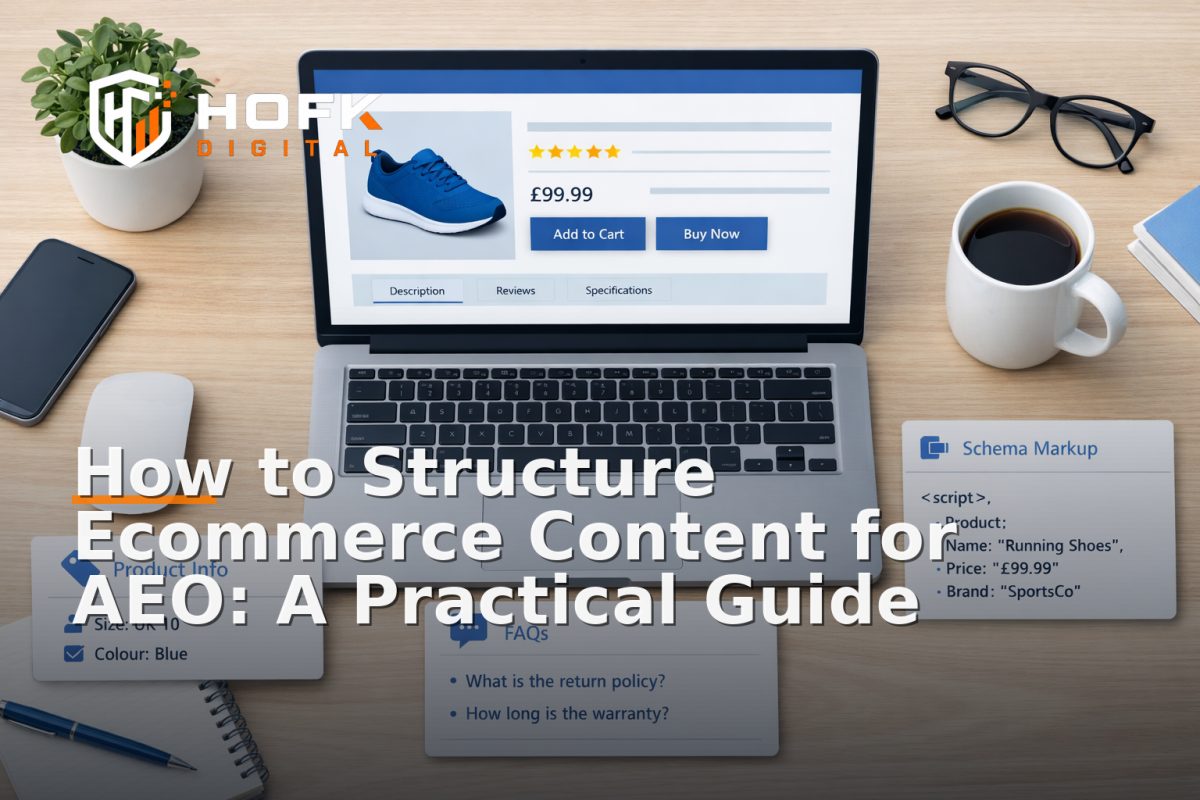
How to Structure Ecommerce Content for AEO: A Practical Guide
If you want your ecommerce site to show up more often in AI search results, the answer is usually not to write more content. It is to structure the content you already have so it is easier for machines and people to understand.
That matters because AI search tools, answer engines and modern search systems tend to prefer pages that are clear, specific and well organised. For ecommerce businesses, that means product pages, category pages and FAQs need to do more than look good. They need to communicate what the product is, who it is for, how it differs from alternatives and what questions a buyer is likely to ask.
This is where AEO comes in. If you treat AEO as a content structure problem rather than just a buzzword, you can make your ecommerce pages easier to cite, easier to scan and easier to trust.
What AEO means for ecommerce
AEO is often used to describe content that performs well in AI-driven search experiences. For ecommerce teams, that usually means giving search systems enough context to confidently match a query to a product, category or answer.
In practice, that does not mean writing for robots instead of customers. It means removing ambiguity. A page about a stainless steel water bottle should make that obvious. So should the material, size, intended use, care instructions and any variant differences. If those details are buried in generic marketing copy, the page is harder to interpret.
Good AEO content helps with SEO too, because clearer pages are often more useful to users and easier for search engines to index properly.
Start with one page, not the whole site
Many teams try to improve every page at once and end up changing too much. A better approach is to start with your highest-value templates:
- Top-selling product pages
- Category or collection pages
- Buying guides
- FAQ pages
- Shipping, returns and delivery pages
These pages are the most likely to influence purchase decisions and the most likely to be referenced by AI-generated answers. If you can make these page types clearer, the benefit usually spreads across the site.
Use a consistent content order on product pages
One of the simplest ways to improve AEO is to use the same information order on every product page. Consistency helps both users and machines.
A practical product page structure looks like this:
- Product name that identifies the item clearly
- One-sentence summary that explains what it is and who it is for
- Key features in bullet points
- Specifications such as size, material, compatibility or dimensions
- Benefits explained in plain language
- FAQs answering the most common buying questions
- Delivery, returns and support information
This structure works because it separates facts from persuasion. AI systems can extract the factual elements more easily when they are not buried in long paragraphs of marketing copy.
Write product summaries like an answer
The opening line of a product page should do a useful job. Avoid vague introductions like “discover the next level of comfort and style”. Instead, say what the product actually is.
For example:
- Weak: “A premium solution for everyday hydration.”
- Better: “A 750ml insulated stainless steel water bottle designed to keep drinks cold for up to 24 hours.”
That second version gives AI systems a clear entity, a use case and a measurable feature.
Make entities obvious
One of the most important parts of AEO is entity clarity. An entity is simply a thing that can be identified unambiguously: a product, brand, material, size, location or feature.
On ecommerce pages, confusion often comes from imprecise language. For example, if a page mentions “eco-friendly”, “premium quality” and “designed for modern lifestyles” without naming the actual material or use case, it is harder to index accurately.
To improve entity clarity:
- Use exact product names consistently
- Spell out dimensions, materials and compatible uses
- Refer to known brands or standards where relevant
- Use one term for one thing across the site
- Avoid switching between similar labels for the same product type
If your store sells a product in multiple colours, sizes or formats, make sure those variants are described in a way that is easy to distinguish. This is especially important where AI tools may need to compare options or summarise differences.
Structure FAQs for direct answers
FAQ content is one of the most useful parts of an ecommerce site for AEO because it matches the way people ask questions in AI search tools. The key is to keep each question specific and each answer short, factual and self-contained.
Good ecommerce FAQs often cover:
- What the product is made from
- How to use it
- How to choose the right size or variant
- Whether it is compatible with another item
- How long delivery takes
- What the returns policy is
Each answer should work on its own. If someone copied only that answer into a response, it should still make sense.
Example:
Question: “Is this backpack suitable for cabin baggage?”
Answer: “Yes, this backpack measures 40 x 20 x 25 cm and is designed to fit most UK cabin baggage requirements, but airline rules can vary. VERIFY with the specific airline before travel.”
That answer is useful because it is direct, precise and cautious where needed.
Use headings that reflect user intent
AI systems rely heavily on page structure, and headings are a big part of that. Generic headings such as “About the product” or “More information” are less helpful than headings that reflect what the section actually covers.
Better heading patterns include:
- Product overview
- Key features
- Specifications
- Size guide
- Care instructions
- Delivery and returns
- Common questions
These headings help AI and SEO systems separate one type of information from another. They also make the page easier for busy shoppers to scan.
Keep one page focused on one intent
A common ecommerce mistake is trying to answer every possible question on one page. That can make pages bloated and difficult to interpret.
For better AEO, each page should have a clear job:
- Product page: explain one item clearly and help the user decide
- Category page: help the user compare options within a group
- Guide page: explain how to choose, use or maintain a product
- FAQ page: answer practical purchase and post-purchase questions
If a category page starts reading like a buying guide, or a product page starts trying to cover every related topic, the signal becomes less clear. That can weaken both SEO and AI search visibility.
Add schema where it supports the content
Schema does not replace good writing, but it helps structured data reinforce what the page already says. For ecommerce, the most relevant types often include product, review, FAQ and breadcrumb markup.
The point is not to add schema for its own sake. It is to make the page easier for systems to interpret consistently.
Useful schema habits include:
- Matching the visible page content with the structured data
- Keeping product fields accurate and up to date
- Using FAQ schema only where there are genuine questions and answers on the page
- Ensuring breadcrumbs reflect the real site hierarchy
If your product data is already maintained in a structured way, this is where full stack development support can be useful. The key is making sure the content layer, the template and the schema all say the same thing.
Write for comparison as well as description
AI search visibility is not only about answering “what is this?”. It is also about helping users compare one option with another.
On ecommerce sites, that often means explaining:
- What makes this product different from a standard version
- Who it is best for
- What trade-offs exist, if any
- Which variant suits which use case
This is especially useful for more considered purchases. A clear comparison section can reduce uncertainty and give AI tools a concise summary to work from.
For example, a product page might state: “Choose the 500ml size if you want something lightweight for commuting. Choose the 750ml size if you need fewer refills during the day.” That is more helpful than vague marketing language.
Use plain language and avoid filler
AI systems tend to do better with direct language, and so do users. If a sentence is there mainly to sound persuasive, it may be getting in the way of the actual information.
That does not mean sounding robotic. It means being clear. Prefer:
- Specific nouns over abstract claims
- Short paragraphs over long blocks of text
- Concrete features over broad brand language
- Real use cases over generic lifestyle wording
A useful test is this: would a buyer still understand the product if the marketing words were removed? If not, the page probably needs more substance.
A simple checklist for ecommerce AEO content
If you want a quick review process, use this checklist on your key pages:
- Does the page state exactly what the product is?
- Are the key attributes visible near the top?
- Are headings clear and descriptive?
- Do FAQs answer real customer questions?
- Is the product data consistent across the page and schema?
- Can a shopper compare variants without guesswork?
- Is any important information buried in long copy?
If you answer “no” to several of these, the page may be harder for AI search tools to understand than it needs to be.
Where HOFK fits in
For many businesses, improving AEO is not just a writing task. It involves page templates, structured content, technical implementation, SEO planning and sometimes automation behind the scenes.
That is where HOFK’s mix of ecommerce, responsive websites, SEO, Google Ads support and full stack development can help. If your product pages or FAQs need to be reworked so they are clearer for users, easier to maintain and more machine-readable, the underlying structure matters as much as the copy itself.
If content changes need to sync with product data, shipping logic or site templates, a more technical approach may be the cleanest route. HOFK also works with operational software and monitoring, which is useful when content quality depends on accurate, up-to-date site information.
Conclusion: make the page easier to answer
The best way to improve AEO is to make your ecommerce content easier to answer from. That means clear product names, obvious entities, structured FAQs, descriptive headings, accurate schema and a page layout that reflects real buying intent.
When a page is easy for a person to scan, it is often easier for AI systems to quote, summarise and trust. That does not happen by accident. It comes from disciplined content structure, consistent templates and a practical view of what the page is supposed to do.
If you want support with ecommerce content structure, SEO, full stack development or better digital performance, HOFK can help you turn messy page content into something more useful for users and more visible to AI search.
Frequently asked questions
What is AEO in ecommerce?
AEO is a practical approach to structuring content so AI search tools and answer engines can understand, trust and surface it more easily.
Do product pages need to be rewritten for AEO?
Not always. Often the biggest gains come from restructuring existing content, improving headings, adding clearer product facts and tightening FAQs.
Is schema enough on its own?
No. Schema works best when it supports clear visible content. If the page is vague, schema alone will not fix that.
Should every product page have FAQs?
Only if they answer genuine customer questions. Useful FAQs can help both shoppers and AI search visibility, but filler questions should be avoided.
Does AEO replace SEO?
No. AEO is best treated as part of SEO and content strategy, not a replacement for them.