

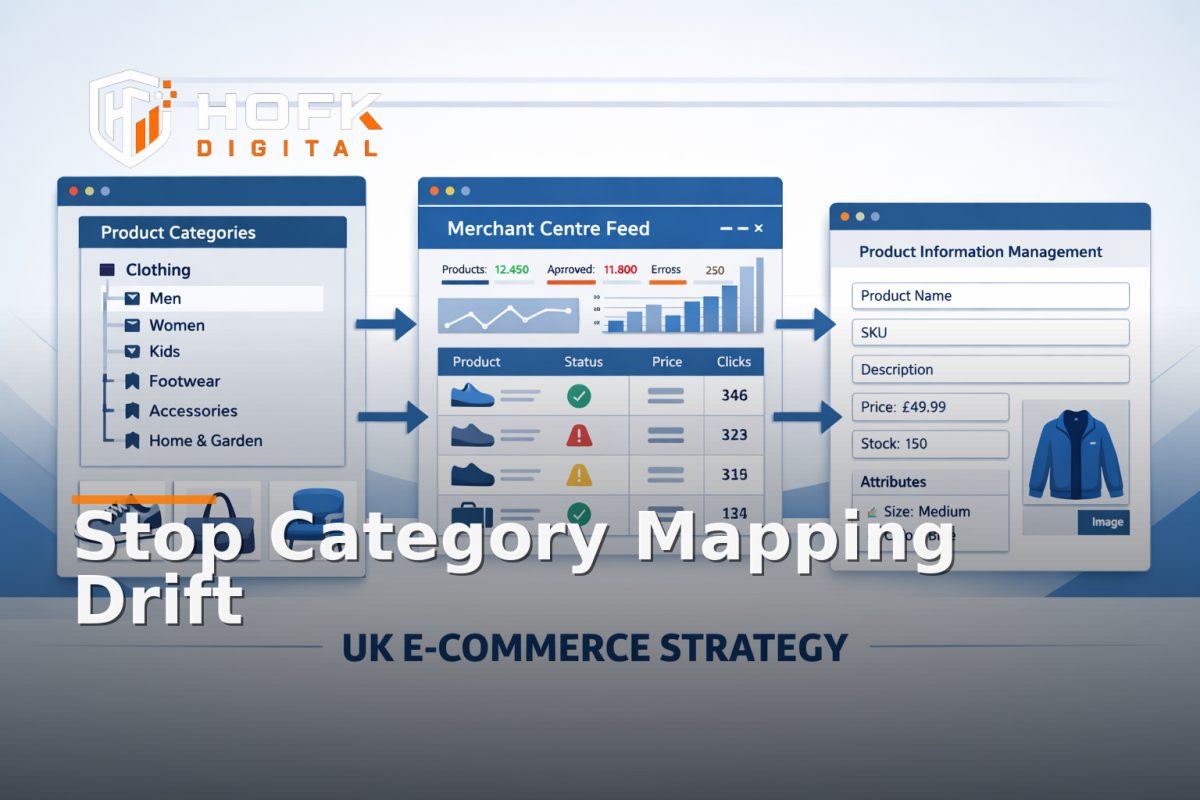
How to Build a Category Mapping Governance Rulebook for Merchant Centre and PIM
If your merchant feed category mapping looks fine on paper but keeps drifting in live channels, the problem is usually not the export. It is governance. One team updates the PIM, another team tweaks a campaign rule, a marketplace needs a different taxonomy, and suddenly the same product sits in three slightly different category systems.
That kind of drift is common once feeds are live. The page still works, Merchant Centre still imports, and the product catalogue still exists, but the meaning of the category has changed somewhere between source, feed and channel. Over time, that creates messy reporting, inconsistent product grouping and avoidable manual fixes.
This article is about building a rulebook that keeps Google Merchant Centre category mapping and PIM taxonomy stable after launch. It is not a launch QA checklist. It is a governance piece for ecommerce managers, merchandisers and performance marketers who need a repeatable way to control category mapping across channels.
Why category mapping needs a rulebook, not just a spreadsheet
A spreadsheet can tell you what the current mapping is. It cannot, on its own, explain who is allowed to change it, what happens when systems disagree, or how to handle exceptions without creating new drift.
That matters because category mapping is not just a technical field. It affects:
- shopping feed relevance
- product discovery in Merchant Centre
- taxonomy consistency in the PIM
- channel-specific reporting
- manual merchandising decisions
If you only manage the mapping as a list of values, every change becomes a local decision. One person optimises for the PIM, another for the shopping feed, and a third for marketplace requirements. The result is a product feed taxonomy that keeps changing shape depending on who touched it last.
Start with the source of truth for each layer
The first job in the rulebook is to define which system owns which part of the taxonomy. Without that, category mapping will keep drifting because people will assume different systems have different authority.
Set ownership for the PIM, not just the feed
The PIM usually owns the product record, but not always the final channel category. That means the rulebook should answer:
- Which category is authored in the PIM?
- Which category is derived for Merchant Centre?
- Which category is allowed to vary by channel?
- Which fields are never edited directly in the feed layer?
If the PIM is the source of truth for the core taxonomy, then category mapping in Merchant Centre should be treated as a controlled transformation, not a separate taxonomy rewrite.
Separate internal taxonomy from channel taxonomy
A common mistake is to force the PIM taxonomy to match every channel taxonomy exactly. That usually creates a structure that is too brittle. Instead, define:
- Internal taxonomy - how your team organises products
- Shopping feed category structure - how Merchant Centre or ad platforms interpret products
- Marketplace taxonomy - any channel-specific grouping or requirement
That separation gives you room to keep the internal model clean while still meeting channel needs. It also makes later changes easier to govern because the team can see whether a requested change is internal, channel-specific or both.
Write the rules around decisions, not just values
A strong governance rulebook should read like operational guidance. It should help someone decide what to do when a category is ambiguous, not only tell them what the current value is.
For example, a useful rule might say:
- If a product belongs to more than one plausible category, the primary category is chosen by commercial intent, not by the PIM folder path.
- If Merchant Centre requires a different classification, the override must be documented and approved by the feed owner.
- If a product is seasonal, the temporary category must have an expiry date or review date.
That kind of decision rule is more useful than a static mapping table because it can survive team changes, catalogue growth and channel expansion.
Build the rulebook around the main failure modes
Most category mapping problems fall into a small number of patterns. If you organise the rulebook around those failure modes, it becomes much easier to use.
1. Ambiguous product classification
Some products naturally fit more than one category. This is common with bundles, hybrid products, accessories and ranges that cross functional boundaries. The rulebook should say who decides the final classification and what evidence they use.
2. Category drift after product changes
A product can move in the PIM, but the feed mapping may stay on the old path. That creates a mismatch between the master record and the shopping feed. The rulebook should define how soon a category change must flow through to Merchant Centre and how exceptions are tracked. VERIFY: exact sync timing depends on your own PIM, feed and refresh schedule.
3. Channel-specific overrides that become permanent
It is common to create a temporary override for Google Merchant Centre category mapping, then forget about it. The rulebook should require all overrides to have a reason, an owner and a review date.
4. Inconsistent naming between teams
Merchandising may use one label, trading another and the PIM team a third. Even if the products are the same, the wording can cause confusion and reporting drift. The rulebook should standardise naming conventions where possible and document approved exceptions where not.
Use a simple decision hierarchy
When a product could fit more than one category, the team needs a clear order of priorities. A practical hierarchy might look like this:
- Customer clarity first - choose the category that most accurately reflects how the shopper would understand the product.
- Channel requirement second - if Merchant Centre or another channel requires a different grouping, apply the channel rule.
- Commercial priority third - if the product supports a campaign, category push or margin objective, document that choice.
- Operational simplicity last - if two options are equally valid, prefer the one that is easier to maintain consistently.
This hierarchy helps prevent category mapping from becoming a debate every time a new SKU lands. It also keeps the rulebook commercially grounded rather than overly technical.
Document the exception process clearly
No taxonomy stays perfect for long. New products, bundles, seasonal ranges and supplier changes will all create exceptions. The question is not whether exceptions happen. It is whether the team has a controlled way to handle them.
Your rulebook should define:
- who can request a mapping exception
- who can approve it
- how the exception is recorded
- when it must be reviewed again
- what happens if the exception affects more than one channel
That gives the business a way to move quickly without losing control. It also reduces the risk of one-off fixes quietly becoming the new normal.
Make the rulebook usable by non-technical teams
A category mapping governance document is only useful if merchandisers, ecommerce managers and marketers can actually use it. If it reads like a technical spec, people will stop referring to it and fall back to memory.
Keep the structure practical:
- One section for ownership
- One section for naming and category rules
- One section for exceptions and overrides
- One section for channel-specific logic
- One section for review cadence
Where possible, use plain English and concrete examples. For instance, show how one ambiguous product is classified, how a seasonal product is treated, and how a category override is logged. Examples are often more useful than abstract policy statements.
Align the rulebook with product data quality
Category mapping only works well if the underlying product data is clean enough to support it. If titles, attributes or product types are inconsistent, the mapping rulebook will end up compensating for weak source data.
That means the rulebook should also point to the product data fields that matter most:
- product type
- brand
- material
- size or dimensions
- variant relationship
- seasonal status
If those fields are incomplete or unreliable, the category logic will be harder to maintain. This is where product data quality and taxonomy structure meet. The cleaner the source data, the less fragile the category mapping becomes.
How to govern multi-channel mapping without overcomplicating it
Many businesses need one taxonomy for several channels, each with its own logic. That is normal. The answer is not to create a different rulebook for every channel. It is to define one core governance model and add channel-specific notes where needed.
A practical approach is:
- Core category rule - the internal taxonomy and the default product assignment
- Merchant Centre rule - any Google Merchant Centre category mapping override or channel-specific adjustment
- Marketplace rule - any marketplace-specific product type or classification requirement
- Review rule - when all channel exceptions are checked together
This keeps the shopping feed category structure aligned while still allowing sensible variation. It also helps the team see when a change should affect all channels and when it should stay limited to one.
Set a review cadence so drift does not build up
A rulebook is only effective if it is reviewed. The right cadence depends on how fast your catalogue changes, but most teams benefit from a regular review of:
- new products
- discontinued products
- category exceptions
- channel overrides
- ambiguous product types
That review should ask one simple question: does the current mapping still reflect how the business wants products grouped and sold? If not, update the rulebook before the drift spreads into reporting and campaign structure.
For larger catalogues, this review can sit alongside broader ecommerce governance or operational meetings. For smaller teams, a monthly check may be enough. The important thing is that the process exists and is owned.
A practical category mapping rulebook checklist
If you need a working structure, your rulebook should include these sections:
- Purpose of the taxonomy and mapping model
- Source of truth for PIM and channel categories
- Decision hierarchy for ambiguous products
- Channel-specific rules for Merchant Centre and marketplaces
- Exception request and approval process
- Review cadence and ownership
- Product data fields required for reliable mapping
That is enough to stop category mapping from becoming a one-off spreadsheet task. It also gives the team a document they can actually use when products change.
Where HOFK fits
HOFK works with ecommerce teams that need product data, feeds and operational workflows to stay aligned. In practice, that often means helping teams define the category mapping logic, reduce drift between PIM and Merchant Centre, and make the product data structure easier to maintain across channels.
That work can sit alongside full stack development, ecommerce support and product data quality improvements. When the taxonomy is clear, the feed is easier to govern. When the feed is easier to govern, the business spends less time cleaning up avoidable mismatches and more time using the data commercially.
Conclusion
If you want stable merchant feed category mapping, you need more than a list of current values. You need a rulebook that explains who owns the taxonomy, how decisions are made, how exceptions are handled and how category drift is reviewed after launch.
That is the practical way to keep Google Merchant Centre category mapping and PIM taxonomy aligned across multiple channels. It also gives your team a cleaner product feed taxonomy and a more reliable shopping feed category structure to work from as the catalogue grows.
If your feeds, PIM structure or category logic need a clearer governance model, HOFK can help with ecommerce support, full stack development and the implementation detail behind cleaner product data workflows.
Related terms: merchant feed category mapping, Google Merchant Centre category mapping, product feed taxonomy, shopping feed category structure.
Published: 2026-07-22
Suggested next step: list your top 20 products, note every category they currently sit in, and mark any item that would be classified differently by another team. Those are your first governance risks.
VERIFY: sync timing, channel category requirements and override behaviour will vary by PIM, ecommerce platform and marketplace.
Frequently asked questions
What is merchant feed category mapping?
It is the process of assigning products to the right categories for Merchant Centre and other channels so the feed reflects a clear and consistent taxonomy.
Why do I need a category mapping governance rulebook?
Because a rulebook defines who owns the taxonomy, how ambiguous products are classified, how overrides are approved and how drift is reviewed after launch.
How is Google Merchant Centre category mapping different from PIM taxonomy?
The PIM taxonomy is your internal product structure. Google Merchant Centre category mapping is the channel-specific interpretation used for shopping feeds and listings.
What causes category mapping drift?
Drift usually happens when the PIM, feed rules and channel requirements are changed by different people without a shared process for ownership and review.
Should every channel use the same category structure?
Not always. It is usually better to keep one internal taxonomy and apply controlled channel-specific mappings where Merchant Centre or marketplaces need them.