

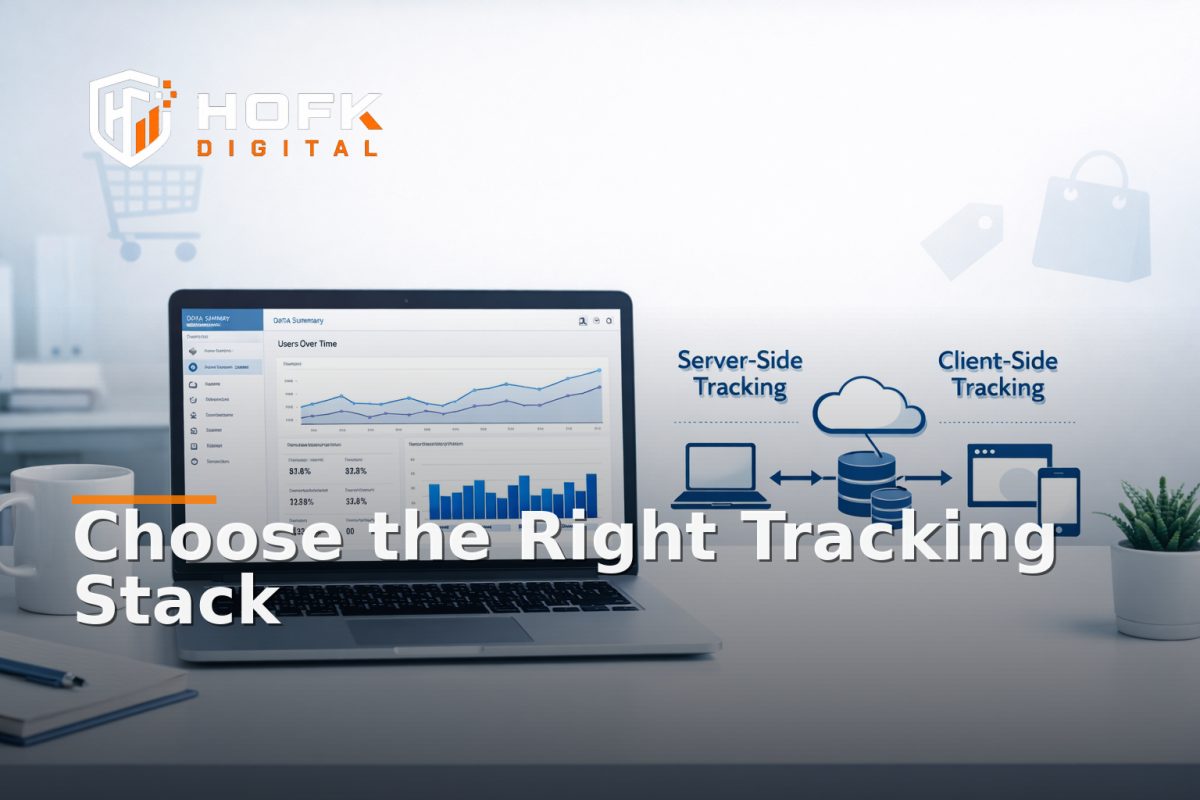
How to Choose Between GA4 Server-Side Measurement and Client-Side Tracking for Ecommerce Reporting
If your ecommerce reporting does not quite add up, the question is not always whether GA4 is broken. More often, the real question is whether your current measurement setup is the right fit for the way your store trades.
For many UK ecommerce teams, the choice between server-side tracking vs client-side tracking is not a technical preference. It is a reporting decision. The right stack depends on how accurate you need attribution to be, how your checkout is built, how consent affects data collection, and how much operational reporting you rely on every day.
This article is not a broad pros-and-cons comparison. It is a practical framework for deciding when to keep client-side tracking, when to add GA4 server-side tracking, and when a mixed approach is the more sensible option.
Start with the reporting problem, not the tool
Before changing tags or moving to server-side measurement, define what is actually going wrong in your current ecommerce analytics setup. Different problems need different fixes.
For example:
- If purchase numbers look reasonable but item detail is weak, the problem may be event mapping or data layer quality.
- If source data disappears after consent, refresh, or cross-domain checkout steps, you may need a more resilient handoff.
- If your reporting is used for budget decisions, stock planning or ops review, the issue may be reliability rather than just attribution.
A useful starting question is: what decision is this reporting supposed to support? If the answer is campaign optimisation only, your needs may be lighter than if finance, trading and operations all rely on the same data.
What client-side tracking is still good at
Client-side tracking is often the right default when the ecommerce journey is simple enough and the browser can still see the important interactions clearly. It remains useful because it is straightforward to implement, fast to iterate and familiar to most marketing teams.
Client-side tracking can be the better option when:
- your store has a relatively standard checkout flow
- you need quick visibility for campaigns and tests
- you are still fixing obvious data layer issues
- the main reporting challenge is setup quality, not browser loss
- you want a lower-complexity analytics stack
For many stores, the best first step is not a new architecture. It is making client-side tracking accurate enough to trust.
If you are still debugging variant mismatches, basket state drift or checkout form state, server-side measurement will not automatically solve those problems. The underlying journey still has to be well instrumented.
When GA4 server-side measurement starts to make sense
GA4 server-side tracking becomes more attractive when the browser is no longer a reliable place to capture everything you need. That often happens when the reporting problem involves consent, multiple domains, payment handoffs or more advanced operational use cases.
Good reasons to consider server-side measurement
- Consent constraints: if browser-based tags are regularly suppressed or delayed, some data may never fire in a useful way.
- Checkout complexity: if your basket, checkout or payment flow spans multiple systems, the browser alone may not preserve a clean record.
- Attribution gaps: if campaign source is being lost between entry and conversion, server-side collection may help preserve more of the journey.
- Reporting confidence: if the business needs cleaner, more stable ecommerce analytics for trading decisions, a server-side layer can add resilience.
- Tag governance: if the site has become crowded with scripts, moving some collection server-side can reduce browser clutter and simplify control.
That said, server-side measurement is not a magic fix. It still depends on good event design, a clear source of truth and sensible governance. If the inputs are messy, server-side simply moves the mess to a different layer.
A decision framework for ecommerce analytics setup
Instead of asking whether server-side is better than client-side, use five practical tests.
1. How important is attribution accuracy?
If your paid media decisions depend on reliable source and conversion data, the quality bar is higher. Stores running active Google Ads campaigns, multiple channels or significant retargeting may need a more robust setup than a small catalogue with light paid media.
If attribution is useful but not business-critical, client-side tracking may be enough for now, provided it is cleanly implemented.
2. How often does the browser lose the thread?
Ask where the data goes missing. Common points include consent banners, mobile browser behaviour, cross-domain checkout, embedded payment tools and page re-renders. If the browser frequently loses state before conversion, server-side measurement may help fill in the gaps.
3. How complex is the checkout journey?
A simple single-domain checkout is easier to track client-side. A flow that moves between subdomains, external providers or separate payment steps is more likely to need additional measurement support. This is especially relevant if orders, refunds or partial payments need to be reported consistently.
4. Who uses the data operationally?
If reporting feeds trading, stock, fulfilment or finance decisions, accuracy matters beyond marketing. In that case, the stack should support the business as a whole, not just ad optimisation. That usually strengthens the case for more structured measurement governance.
5. How much time do you want to spend maintaining it?
Server-side measurement can improve control, but it also adds implementation and maintenance overhead. If the team does not have time to manage the setup properly, a simpler client-side model may be more reliable in practice.
When to keep client-side tracking
You do not need to move everything server-side just because it is possible. In some ecommerce analytics setups, client-side tracking remains the right answer.
Keep client-side tracking when:
- the checkout is simple and mostly first-party
- the data layer is clean and consistent
- browser consent behaviour is not causing major loss
- you need speed of iteration more than extra resilience
- the team is small and the stack needs to stay manageable
This is often the case for smaller ecommerce stores, straightforward brochure-led stores with light ecommerce functionality, or businesses that are still maturing their analytics basics.
In those cases, the better investment may be tag governance, cleaner event naming, improved data layer structure and better QA rather than a full shift in architecture.
When to add server-side measurement on top of client-side tracking
For many stores, the best answer is not one or the other. It is both, with different roles. Client-side tracking can continue to handle visible user interactions, while server-side measurement supports resilience, attribution continuity and downstream reporting.
This mixed approach often works well when:
- you want to keep fast browser-based events for marketing teams
- you need a more reliable path for purchases, refunds or order updates
- your checkout spans domains or services
- you want to reduce dependence on one fragile point of collection
In practice, this lets you preserve the speed of client-side tracking while adding a more controlled layer for key ecommerce events. It can be a good fit when the business wants better reporting without rebuilding every tag.
Questions to ask before you change the stack
Before deciding on GA4 server-side tracking, work through these questions with marketing, development and operations together:
- Which reports do we trust least today?
- Which events matter most commercially?
- Where does source data first go missing?
- Do we need better accuracy, better resilience, or both?
- Can the team maintain a more complex setup properly?
- What is the rollback plan if the new stack causes noise?
If those questions are not answered clearly, the project risks becoming a technology exercise instead of a reporting improvement.
A practical way to choose the right stack
Use this simple rule of thumb:
- Stay client-side if the journey is straightforward, the data layer is clean and the reporting needs are modest.
- Add server-side measurement if consent loss, checkout complexity or attribution gaps are materially affecting confidence in the data.
- Use a hybrid model if you need both speed and resilience, especially where ecommerce reporting supports multiple teams.
That is usually more useful than framing the decision as a binary. The goal is not to move everything into the server. The goal is to make the reporting architecture fit the business.
What a good ecommerce analytics setup looks like
A healthy ecommerce analytics setup is boring in the best way. It is clear about what is collected, where it is collected, and why it matters.
Good setups usually have:
- one defined source of truth for each important event
- clear event naming and governance
- tested consent behaviour
- reliable purchase and refund handling
- repeatable QA for key journeys
- reporting that operations can interpret as well as marketing
That last point matters. If the data only helps the ad account but not the wider business, the stack may be incomplete.
Where HOFK can help
HOFK works across ecommerce, full stack development, SEO, Google Ads, responsive websites, automation and monitoring, so this kind of decision is often approached as a practical implementation problem rather than a dashboard-only problem. In many projects, the useful work is not just turning on GA4 server-side tracking. It is deciding what should stay client-side, what should move, and how to keep the reporting design understandable.
That may involve checking tag governance, improving the data layer, reviewing checkout handoffs, or making the measurement path easier to maintain. For stores with more complex operations, it can also mean aligning analytics with fulfilment, refunds and order workflows so reporting stays useful after launch.
Conclusion
The choice between server-side tracking vs client-side tracking should be made around reporting needs, not fashion. Client-side tracking is still the right answer for many ecommerce stores. GA4 server-side tracking becomes more useful when consent constraints, checkout complexity or attribution gaps are reducing confidence in the data. In some cases, a hybrid approach is the most practical ecommerce analytics setup.
If you are deciding what to change next, start with the business question: what reporting do we need to trust more? Once that is clear, the stack choice becomes much easier to justify and much easier to implement well. If you need support with tag governance, GA4 server-side tracking, reporting design or the development work behind a more reliable measurement setup, HOFK can help.
server-side tracking vs client-side tracking is easiest to solve when the reporting architecture is chosen to match the business, not the other way around.
Frequently asked questions
What is the difference between server-side tracking and client-side tracking?
Client-side tracking collects data in the browser. Server-side tracking collects or relays some data through a server, which can improve control and resilience in certain ecommerce setups.
When should an ecommerce store consider GA4 server-side tracking?
It is worth considering when consent loss, checkout complexity, cross-domain journeys or attribution gaps are materially affecting reporting confidence.
Is server-side tracking always more accurate?
Not always. It can improve resilience and control, but it still depends on good event design, clean data and proper governance.
Can I keep client-side tracking and still improve reporting?
Yes. Many stores get better results by improving tag governance, data layer quality and QA before moving to a more complex setup.
What is the safest approach for a complex ecommerce checkout?
A hybrid setup is often the most practical option, with client-side tracking for visible interactions and server-side measurement for key events that need more reliability.