

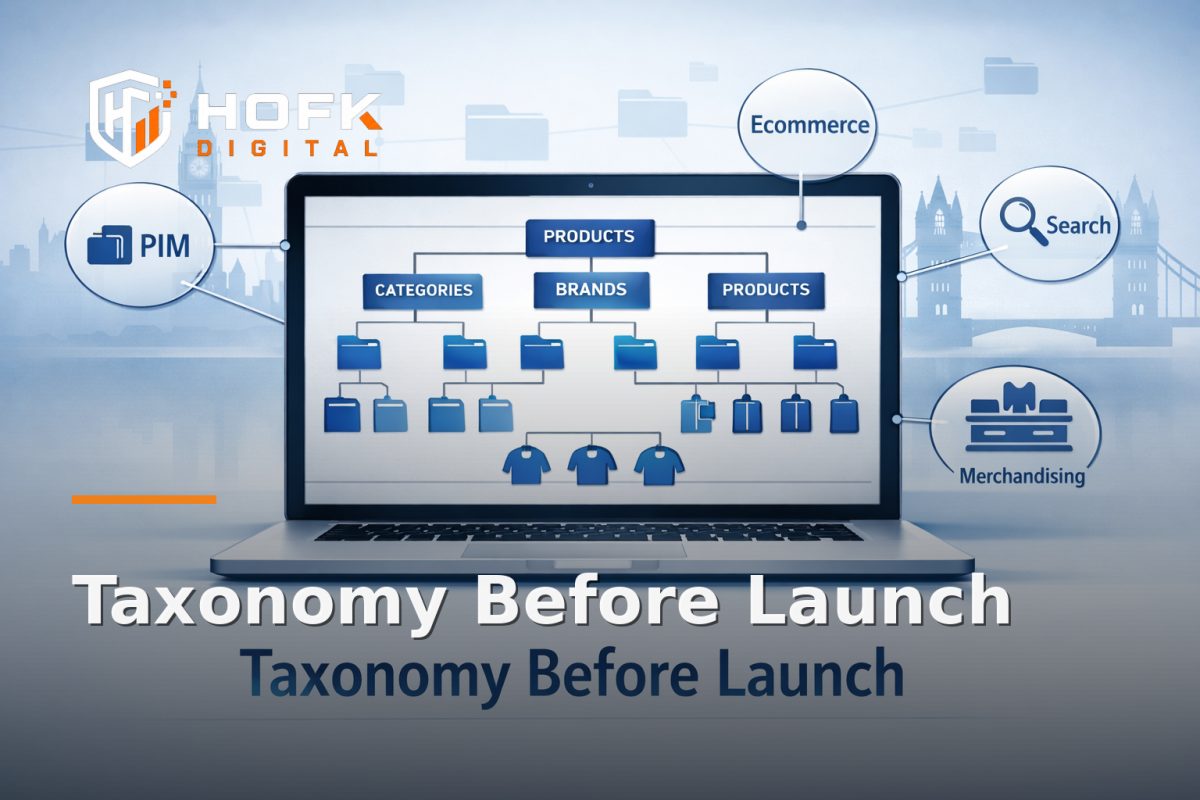
How to Build a Pre-Launch Product Taxonomy Governance Audit for Ecommerce Catalogues
If you are launching a new catalogue structure, the safest time to run a product taxonomy audit is before the catalogue goes live, not after products, search and merchandising rules have already been built around it. Once naming conventions, hierarchy decisions and system mappings are embedded in a PIM, ecommerce platform and search layer, small taxonomy mistakes become expensive to unwind.
That is because taxonomy is not just a back-office label set. It shapes how products are named, grouped, discovered and maintained across the business. If the structure is unclear, the same product may be classified differently in the PIM, storefront, search tool and merchandising layer. The result is catalogue drift: inconsistent names, confusing hierarchies, weak joins between systems and avoidable launch friction.
This article is for UK founders, ecommerce managers, merchandisers and commercial leads who need a practical governance audit before a new catalogue structure or product launch. The focus is on taxonomy ownership, hierarchy design, change-control and mapping rules across systems, not on category page optimisation or feed QA.
Why taxonomy governance matters before launch
A taxonomy works only when people agree how it should be used. If no one owns the rules, teams tend to make local decisions that feel sensible in the moment but create inconsistency over time. That is especially common when product, content, search and trading teams all touch the same catalogue.
A pre-launch taxonomy governance audit helps you answer four questions:
- Who decides what the product should be called?
- Who decides where it sits in the hierarchy?
- What happens when two systems disagree?
- How will future changes be approved and tracked?
If those answers are not clear, the catalogue may launch quickly, but it will be harder to maintain, harder to search and harder to trade. In many cases, the first symptoms show up as duplicate naming, mismatched product groups, inconsistent attributes or manual workarounds that no one planned for.
Start with the business purpose of the taxonomy
Before you define labels, decide what the taxonomy is for. A taxonomy used for ecommerce discovery should not be identical to one used for reporting, fulfilment or internal operations. In practice, most businesses need one visible structure and one or more supporting structures underneath it.
Ask what the taxonomy must do in your business:
- Help shoppers find the right product quickly
- Keep product naming consistent across channels
- Support search, filters and merchandising rules
- Make internal management easier for teams
- Reduce duplicated manual classification work
If the answer is simply “organise products”, the scope is too vague. A better taxonomy brief states what decisions it should support and which system is the source of truth for each part of the structure.
Define ownership before naming anything
One of the most useful parts of a product classification audit is finding out who actually owns the taxonomy. If ownership is unclear, people will edit names, attributes or hierarchy paths in different systems and assume the others will follow.
Identify the decision owners
For a launch-ready governance model, assign named owners for the following:
- Taxonomy owner - responsible for the structure and naming rules
- Product data owner - responsible for accuracy in the PIM or source system
- Ecommerce owner - responsible for how the taxonomy is used on the storefront
- Search owner - responsible for how the hierarchy is indexed and queried
- Merchandising owner - responsible for commercial placement and product grouping
One person may hold more than one of these roles in a smaller team, but the responsibilities still need to be explicit. If not, taxonomy changes will be delayed, duplicated or made inconsistently.
Decide who can approve changes
Ownership is not the same as edit access. A good governance model should define who can request a change, who can approve it and who can publish it. That is particularly important if the catalogue structure affects customer-facing navigation, search logic or campaign landing pages.
For example, a merchandiser may propose a new product group, but the taxonomy owner should approve the hierarchy change before it is published. Without that control, the catalogue can drift away from its own rules.
Build naming conventions that people can actually use
Most taxonomy problems start with naming. If product names, category names and attribute labels are not written consistently, the structure becomes harder to maintain and harder to search.
A practical naming convention should be simple enough for non-technical users to apply and strict enough to prevent drift. You are not trying to create perfect language. You are trying to create predictable language.
What to standardise
- Singular versus plural forms
- Capitalisation rules
- Abbreviations and acronyms
- Use of brand names versus generic product names
- Order of attributes in names
- Variant naming conventions
For example, if one team writes “T Shirts”, another writes “T-Shirts” and another writes “Tshirt”, the taxonomy is already weaker than it should be. The same applies to inconsistent colour names, material labels or internal shorthand that customers never see but systems still depend on.
Write naming rules for humans, not just systems
Good naming rules should explain what to do, not just what not to do. A useful standard might state that product names should use the commercial product type first, followed by the brand, then the key differentiator. Another rule might require variant values to use the same vocabulary everywhere they appear.
If your team needs to guess how to classify a product, the naming guide is too thin.
Design the hierarchy around how the catalogue is managed
A taxonomy hierarchy should reflect how products are actually grouped, maintained and traded. If the structure is too flat, teams cannot separate meaningful groups. If it is too deep, maintenance becomes painful and users get lost.
This is where catalogue structure optimisation becomes a governance issue rather than a visual one. The best hierarchy is not the one with the most levels. It is the one that makes classification, search and maintenance easier.
Ask these hierarchy questions
- Does each level add useful meaning?
- Can the structure be maintained by the team that owns it?
- Are there too many near-duplicate groups?
- Will the hierarchy still make sense when new products are added?
- Can the same product fit the same structure every time?
If the answer to any of those is uncertain, the hierarchy may need simplifying before launch. It is much easier to fix a structure on paper than after thousands of products are already assigned to it.
Map the rules between PIM, ecommerce platform, search and merchandising systems
A taxonomy governance audit is not complete until you check how the structure travels between systems. The PIM may hold the source data, the ecommerce platform may render the product pages, the search tool may index the labels and the merchandising layer may alter visibility or priority. If each system interprets the taxonomy differently, the catalogue will not behave consistently.
Define the source of truth for each field
For every important field, document which system owns it. For example:
- Product name - PIM or product master
- Category path - ecommerce taxonomy layer
- Variant attributes - source product record
- Search labels - search index mapping
- Merchandising priority - trading or campaign rule set
If two systems can edit the same field, define which one wins. If a system can only read a field, note that too. The goal is to prevent hidden conflicts when product information changes.
Document transformation rules
Some fields will not travel unchanged. A value in the PIM may need to be shortened, normalised or mapped differently for the ecommerce platform or search index. That is fine, but the rule needs to be written down.
Examples of transformation rules include:
- Long product names shortened for display
- Internal codes converted into customer-facing labels
- Attribute values standardised across the range
- Hierarchy labels mapped into search-friendly terms
If you do not document the transformation, the same product can appear differently depending on which system last touched it.
Run a product taxonomy audit on a representative sample
Before you launch the full catalogue structure, audit a sample of products that reflects the range of complexity in the business. Do not only test the easy items.
Choose products that expose risk
- A simple single-SKU product
- A variant-heavy product with multiple attributes
- A product with a long name or many descriptors
- A product that belongs to more than one logical group
- A product that is commercially important to the business
- A product that will be used across multiple channels
For each item, check whether the naming, hierarchy and attribute values are consistent across the PIM, ecommerce platform, search layer and merchandising tools. If one product is classified differently in each place, the taxonomy rules are not ready yet.
Look for the failure patterns early
Common issues include duplicate category names, conflicting attribute labels, products assigned to the wrong hierarchy level, variant values that are not standardised and search labels that no longer match the catalogue structure. These are the kinds of issues that become expensive to repair after launch because the catalogue has already been built around them.
Create taxonomy change-control before go-live
Taxonomy governance is not only about launch readiness. It is also about what happens after launch when new products, seasonal ranges or commercial changes arrive. If there is no change-control process, the taxonomy will drift back into inconsistency very quickly.
Set a simple change-control flow
Every taxonomy change should follow the same steps:
- Request the change with a clear reason.
- Review the impact on naming, hierarchy and system mappings.
- Approve or reject the change.
- Update the relevant source and connected systems.
- Record what changed and why.
If the change affects customer-facing discovery, search or merchandising, the owner should also check whether the update introduces any conflicts with existing rules. This does not need a heavy process, but it does need a reliable one.
Decide which changes need approval
Not every edit needs the same level of review. A spelling correction may be low risk. A category restructuring that affects thousands of products is not. Use a risk-based approach so the team can move quickly on small fixes while still protecting major structural decisions.
A sensible rule is:
- Low-risk edits - can be made by the taxonomy owner
- Medium-risk edits - need one additional approval
- High-risk structure changes - need documented sign-off
That gives you governance without unnecessary delay.
Make the taxonomy maintainable for real teams
The best taxonomy is one that people can keep using. If the rules are too complicated, the team will work around them. That is how catalogue drift starts.
Keep the rules short and practical
A useful taxonomy guide should fit on a small number of pages or a compact internal reference. It should answer the questions people actually ask when classifying a product:
- What do we call this product?
- Where does it sit in the hierarchy?
- Which attributes are mandatory?
- Which system owns the value?
- What happens if the value changes?
If the team needs a meeting every time a product is added, the taxonomy is too fragile. The goal is not to remove judgement entirely. It is to reduce unnecessary judgement by making the structure clear.
Plan for new ranges before they arrive
Many taxonomy problems appear when a business launches something new: a seasonal range, a bundle structure, a new product line or a new channel. Before launch, test whether the current taxonomy can support the new items without creating exceptions. If not, adjust the structure first rather than patching it later.
What a launch-ready taxonomy audit should produce
At the end of the audit, you should have a clear set of outputs that can be used by ecommerce, product, search and development teams.
- A named taxonomy owner
- Written naming conventions
- A hierarchy model that is easy to maintain
- Source-of-truth rules for each system
- Transformation rules for mapped fields
- A sample product review showing how the rules behave
- A taxonomy change-control process
- A short reference guide for the team
If you do not have those artefacts, the catalogue is not fully governed yet. It may still launch, but it will be harder to keep clean over time.
Where HOFK fits
This kind of work sits between ecommerce, full stack development, product data and operational workflow. HOFK works with ecommerce support, full stack development, responsive websites, SEO, Google Ads and practical automation, so taxonomy reviews can be handled as part of a wider catalogue and implementation process rather than as a one-off spreadsheet exercise.
In practice, that may mean checking how catalogue structure maps into the PIM, how the ecommerce platform renders it, how search consumes it and how merchandising rules depend on it. For businesses preparing a new catalogue launch, that technical detail matters because the taxonomy is only useful if the systems behind it agree.
Conclusion
A product taxonomy audit is one of the most practical ways to reduce launch risk before a new catalogue goes live. If you define ownership, write naming rules, design a maintainable hierarchy, map system boundaries and set change-control in advance, you give the catalogue a structure that teams can actually use.
That is the real value of a taxonomy governance audit: not just a cleaner product tree, but a catalogue that is easier to maintain, easier to search and less likely to drift as the business grows. If your ecommerce taxonomy structure needs a clearer plan before launch, HOFK can help with the technical and operational detail behind catalogue structure optimisation, full stack development and product data workflows.
Target keyword: product taxonomy audit
Related terms: ecommerce taxonomy structure, catalogue structure optimisation
Frequently Asked Questions
What is a product taxonomy audit?
A product taxonomy audit is a review of how products are named, grouped and governed across systems before launch. It checks ownership, hierarchy design, naming rules and mapping between the PIM, ecommerce platform, search and merchandising tools.
What should be included in an ecommerce taxonomy structure review?
At minimum, it should cover ownership, naming conventions, hierarchy levels, source-of-truth rules, transformation logic and change-control. It should also test a sample of products across the connected systems.
Who should own taxonomy governance?
Usually one person or team should own the taxonomy itself, with clear input from ecommerce, product data, search and merchandising. The important thing is that ownership is explicit, not assumed.
Why does taxonomy change-control matter?
Without change-control, catalogue changes are made locally and inconsistently. That leads to drift between systems and makes the structure harder to maintain after launch.
What is the difference between taxonomy and merchandising?
Taxonomy is the structure and naming of the catalogue. Merchandising is how products are promoted or prioritised within that structure. Both affect ecommerce performance, but they are not the same thing.