

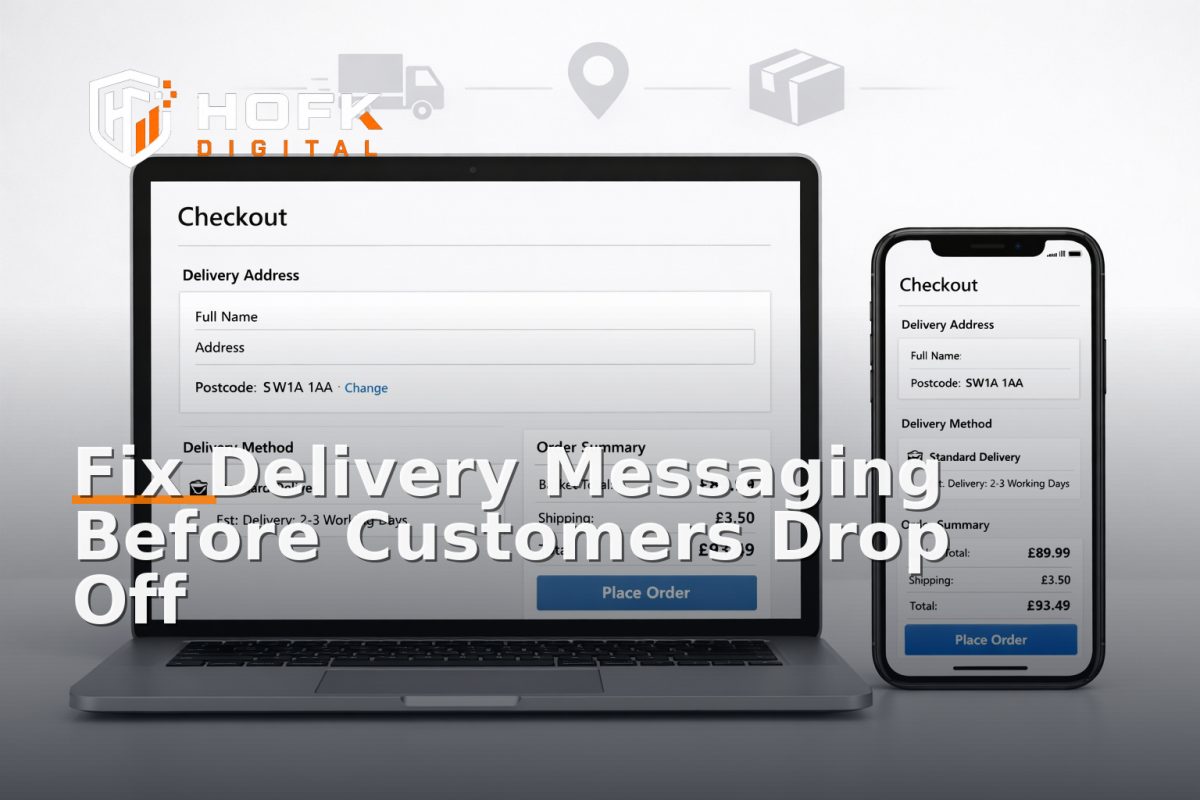
How to Audit Ecommerce Checkout Delivery Messaging for Clarity, Trust and Basket Completion
If customers are getting all the way to checkout and then hesitating, the problem is not always price, payments or form length. Sometimes it is the delivery message itself. ecommerce checkout delivery messaging has a direct commercial effect because it is often the last thing a shopper checks before committing to the order.
At that point, small ambiguities become expensive. If the delivery copy is vague, the ETA wording is inconsistent, the free-delivery threshold is hard to spot, or postcode restrictions appear too late, shoppers may pause long enough to abandon the basket. In most cases, the issue is not that the business lacks delivery information. It is that the information is not governed clearly enough.
This article is for UK ecommerce managers, founders, marketers and operations leads who want to audit delivery messaging on checkout without rebuilding the platform. The focus is narrow: not general checkout design, not payments, and not broader funnel optimisation. The aim is to review the content hierarchy, rule accuracy and operational consistency of checkout delivery information so the buyer can understand what happens next.
What delivery messaging on checkout is supposed to do
Checkout delivery information has one job: remove uncertainty at the point of decision. If the customer already wants the product, the delivery message should help them answer a few simple questions quickly:
- When will it arrive?
- How much will it cost?
- Are there any restrictions?
- Is there a faster option if I need it sooner?
If those answers are unclear, the customer has to do the mental work themselves. That is where trust starts to slip. Good delivery messaging on checkout does not try to say everything. It says the right things in the right order.
Start by mapping the delivery message hierarchy
Before changing copy, map the delivery information exactly as it appears to the shopper. On many live checkouts, the problem is not the individual sentence. It is the order in which the messages appear and how much attention each one gets.
A useful hierarchy for delivery messaging usually follows this sequence:
- Primary promise — the headline delivery message or expected arrival window.
- Commercial condition — standard, express or nominated delivery.
- Price signal — delivery cost or free-delivery threshold.
- Restriction — postcode limitations, excluded regions or product-specific rules.
- Fallback or support route — what to do if the delivery option is not available.
If the checkout puts the restriction before the promise, or the cost before the context, the message can feel more like a warning than a reassurance. That can be enough to slow the customer down.
Check whether the wording matches the operational reality
The most important part of a delivery message audit is accuracy. If checkout delivery information is slightly out of step with how fulfilment actually works, customers notice. They may not articulate the problem, but they often react to it by delaying or leaving.
Review the wording against the real operating rules:
- Does the ETA reflect current warehouse cut-off times?
- Does the free-delivery threshold match the live basket rule?
- Do postcode restrictions reflect the actual service areas?
- Does express delivery only appear where it can genuinely be fulfilled?
- Do product-specific delivery notes still match stock and despatch behaviour?
This is content governance as much as UX. If the delivery copy is written once and then forgotten, it can become a liability. The checkout should not promise what operations cannot consistently deliver.
A simple accuracy test
Pick three recent orders, one standard basket, one basket near the free-delivery threshold and one with a restricted postcode or express request. Compare what the checkout says with what the business actually fulfilled. If there is any mismatch, the content needs review.
Audit ETA wording for clarity, not just correctness
ETA wording often causes confusion because different teams describe the same thing differently. Operations might use working days. Marketing may prefer customer-friendly language. Customer service may simplify it further. In checkout, that inconsistency can be enough to reduce confidence.
When reviewing ETA wording, look for these issues:
- Relative wording such as “soon” or “fast delivery” without a concrete expectation.
- Mixed timeframes where one message says next day and another says 2–3 working days.
- Hidden cut-offs where a headline sounds immediate but the small print changes the meaning.
- Ambiguous dates where the customer cannot tell whether the date is dispatch or arrival.
A stronger ETA message is specific enough to feel reliable, but not so detailed that it becomes hard to maintain. For example, “Order by 2pm for delivery tomorrow” is easier to interpret than “Rapid fulfilment available”. If the checkout uses working-day language, make sure it is consistent across the site and not undermined by a different promise elsewhere.
Review free-delivery thresholds for visibility and positioning
Free-delivery thresholds can be commercially useful, but only if they are visible early enough and worded clearly enough to influence the basket. If the threshold only appears deep in checkout, it may be too late to affect the decision.
When auditing free-delivery messaging, ask:
- Is the threshold visible before the customer reaches the delivery step?
- Does the checkout repeat the threshold close to the basket total?
- Is the remaining amount to qualify shown clearly?
- Is the message simple enough to understand at a glance?
The question is not just whether the threshold exists. The question is whether it is doing useful commercial work. If it is too hidden, customers may not add another item to qualify. If it is too prominent but unclear, it can create friction rather than motivation.
For UK ecommerce teams, this is one of the areas where ecommerce checkout optimisation can be improved without changing the platform. Often the fix is about placement, wording and consistency rather than redesign.
Check postcode restrictions before the customer commits
Postcode restrictions are especially sensitive because they can turn a near-complete purchase into a disappointment if they appear too late. If a shopper only discovers a restriction after investing effort in the basket, the experience feels avoidable.
Audit the handling of restricted postcodes in three places:
- Before checkout — is there any guidance on the product page or basket for restricted regions?
- At checkout entry — does the checkout set expectations early?
- At validation — is the message clear, polite and specific?
The wording should explain the restriction without sounding defensive. If a postcode cannot be served, the message should say so plainly and, where appropriate, offer the nearest workable alternative. That may be a different delivery method, a collection route, or a request to contact support if the order is exceptional.
What good restriction messaging looks like
Good restriction copy is specific, non-technical and actionable. It tells the customer what is not available and what they can do instead. Bad restriction copy tends to be vague, overly cautious or abrupt.
Make express options understandable, not decorative
Express delivery is only useful if the customer can see when it applies and what it changes. If the option exists in the checkout but is not easy to compare with standard delivery, it can create more confusion than value.
When auditing express delivery messaging, check:
- Is the express option clearly labelled?
- Does the copy explain the cutoff time or qualifying conditions?
- Is the arrival window more useful than a generic speed claim?
- Does the cost difference make sense alongside the benefit?
For example, “Next-day delivery available if ordered before 2pm” is clearer than “Express service available”. The shopper does not need marketing language here. They need a decision they can trust.
Test whether delivery messages stay consistent across checkout states
One of the easiest ways for delivery messaging to go wrong is through state change. The checkout may show one message at first, then update after a postcode entry, basket change, login or fulfilment recalculation. If that update is not obvious, the customer may think the system is unreliable.
Review the delivery message in these states:
- Initial checkout load
- After postcode entry
- After basket value changes
- After switching between delivery methods
- After refresh or browser back button use
If the wording changes, the hierarchy should still make sense. If a standard message becomes an express message, or a delivery estimate tightens after a postcode is entered, the page should make the reason clear. Hidden changes are a common source of doubt.
Audit who owns the delivery copy
Many checkout issues persist because nobody owns the content. Operations may own the fulfilment rules, marketing may own the wording, and development may own the implementation. If those responsibilities are not defined, the delivery message can drift for months.
A practical governance model should answer:
- Who approves ETA wording?
- Who updates threshold copy when the delivery policy changes?
- Who checks postcode restriction text after operational updates?
- Who signs off any express delivery messaging before launch?
This matters because checkout delivery information is operational content. It should be maintained with the same care as pricing or stock. If the site can update product availability quickly but not delivery wording, the customer experience becomes inconsistent.
Compare the checkout message with the rest of the journey
Delivery messaging on checkout should not contradict what the customer saw earlier in the journey. If a product page implies free delivery, the basket and checkout should not introduce the threshold as a surprise. If a campaign ad suggests a fast delivery promise, the checkout should reinforce it rather than weaken it.
This means reviewing the entire delivery narrative:
- Product page delivery promise
- Basket delivery summary
- Checkout delivery step
- Confirmation messaging after order
When these do not match, the checkout is often blamed unfairly. The real issue may be a message mismatch across the journey. For paid traffic, that can matter even more because the promise has already been set by the ad or landing page.
A practical audit sequence for live stores
If you need to review ecommerce checkout delivery messaging in a structured way, use this sequence:
- Open the checkout as a customer would.
- Read the delivery message before entering any details.
- Check whether the ETA wording is specific and consistent.
- Confirm that thresholds and restrictions are visible and understandable.
- Test a normal postcode, a restricted postcode and an express delivery scenario.
- Compare the wording with real fulfilment rules.
- Repeat the check after basket changes and refreshes.
If the same wording feels unclear in more than one scenario, it probably needs a governance update rather than a copy tweak alone.
Checklist: what to look for in delivery messaging on checkout
- Does the checkout explain delivery timing clearly?
- Are free-delivery thresholds easy to spot?
- Are postcode restrictions shown early enough?
- Is express delivery phrased in a way customers can understand quickly?
- Do the messages match the actual operational rules?
- Does the wording stay consistent across checkout states?
- Is there a named owner for ongoing updates?
When the problem is technical as well as editorial
Sometimes the delivery message is fine in principle, but the template, state logic or data source makes it unreliable. For example, the checkout may be pulling old delivery rules, failing to refresh after a postcode change, or showing different copy on mobile and desktop.
In those cases, the issue is no longer just editorial. It may need practical development support to make the checkout easier to maintain. HOFK often works in the overlap between ecommerce, full stack development, responsive websites and operational software, which is useful when delivery messaging depends on the way the checkout is built as much as the words on the page.
If the message hierarchy keeps drifting, or if a content update keeps getting undone by the template, the checkout may need a cleaner implementation path rather than more manual fixes.
Conclusion
Clear ecommerce checkout delivery messaging is not a cosmetic detail. It is part of the decision-making process. If the ETA wording is confusing, the free-delivery threshold is hard to find, postcode restrictions appear too late, or express options are poorly explained, the customer has more reason to hesitate at the final step.
The most useful audit is simple: check whether the delivery content is accurate, understandable and governed in a way that reflects the real operation. That is how you improve checkout delivery information without rebuilding the platform. For many UK stores, better messaging is one of the most practical ways to reduce basket abandonment on the delivery step.
If your checkout needs clearer delivery copy, stronger content governance or technical support behind the delivery logic, HOFK can help with ecommerce, full stack development, website monitoring and practical operational improvements.
ecommerce checkout delivery messaging works best when it is clear, consistent and true to how the business actually fulfils orders.
Frequently asked questions
What is ecommerce checkout delivery messaging?
It is the delivery-related copy and information shown during checkout, such as ETA wording, free-delivery thresholds, postcode restrictions and express options.
Why does delivery messaging affect basket completion?
If the delivery information is unclear or inconsistent, customers may hesitate at the final step and leave before completing the order.
What should I audit first in checkout delivery information?
Start with the message hierarchy: delivery timing, costs, thresholds, restrictions and express options. Then check whether the wording matches the real operational rules.
How do I know if the problem is content or technical?
If the wording is correct in principle but changes unexpectedly, pulls old rules or behaves differently by state or device, the issue may need technical review as well as copy changes.
Should delivery messages be shown before checkout?
Often yes. Customers benefit from seeing key delivery details earlier in the journey, especially free-delivery thresholds and postcode restrictions.