

How to Govern Product Claims and Specifications Across Ecommerce Channels
A product page says an item is waterproof. A marketplace listing says water-resistant. The merchant feed uses a shorter description, while a supplier document includes a technical specification that nobody in the catalogue team has approved.
These differences may look minor, but they can create customer confusion, support queries, feed inconsistencies and avoidable commercial risk. The problem is rarely just poor copy. It is usually a governance gap: nobody has clearly defined who owns the claim, what evidence supports it, where it can be used and when it needs review.
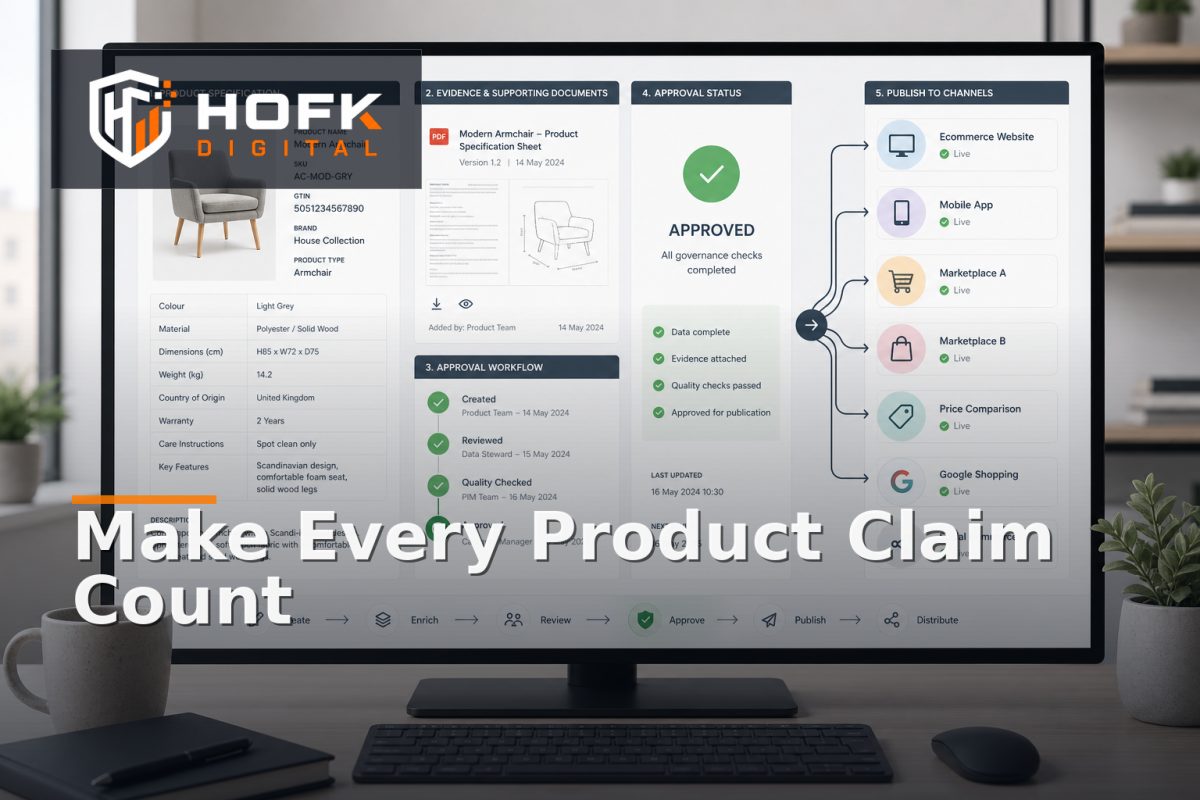
Ecommerce product claims governance gives teams a repeatable way to control product claims and specifications across product pages, category pages, feeds, marketplaces, PDFs and customer-service content. The goal is not to slow down catalogue updates. It is to make published information consistent, traceable and proportionate to its risk.
What product claims governance needs to control
Product information normally includes several different types of content. They should not all be approved in the same way.
- Identity data: brand, model, SKU, GTIN, product type and variant.
- Technical specifications: dimensions, weight, capacity, voltage, materials, compatibility and pack quantity.
- Performance claims: waterproof, energy efficient, long-lasting, fast, durable or suitable for a particular use.
- Commercial content: price, discount, availability, delivery promise and warranty wording.
- Compliance data: certificates, markings, warnings, restrictions and supporting documentation.
Each group may have a different source of truth and approval owner. A supplier may provide technical measurements, while the ecommerce team owns the customer-facing title. A compliance or technical owner may need to approve a performance claim before it appears in a feed or advert.
Start with a field-level ownership matrix
Do not assign one source of truth to the entire product record. Product governance works better when ownership is defined at field level.
Your matrix should identify:
- The attribute or claim.
- The preferred source.
- The evidence required.
- Whether the value can update automatically.
- Who approves publication.
- Which channels may use the value.
- When the value must be reviewed.
For example, an ERP may own stock and price, a PIM may own product relationships, a manufacturer document may support dimensions, and the catalogue team may own the customer-facing description. Keeping these responsibilities separate prevents an incoming feed from overwriting approved content simply because it is newer.
Separate specifications from marketing claims
A specification describes a measurable or definable product characteristic. A claim communicates a conclusion about what the product does or why it is valuable. The distinction matters.
For example:
- Specification: “Stainless steel, 750ml capacity.”
- Claim: “Keeps drinks cold all day.”
- Specification: “IP rating recorded in the technical documentation.”
- Claim: “Suitable for outdoor use in wet conditions.”
The second statement in each pair may require more interpretation and stronger evidence. Product specification management should therefore preserve the underlying fact separately from the customer-facing claim derived from it.
This also makes changes easier to manage. If a specification changes, the team can identify which claims, filters, comparison tables and feed attributes may be affected.
Use an evidence record for higher-risk claims
Claims should not be approved from memory or copied from an old product description. Create an evidence record for claims that could materially affect a buying decision.
An evidence record might include:
- Claim text and internal claim ID.
- Product, variant or product-family reference.
- Source document, test result or supplier confirmation.
- Date received and document version.
- Conditions or limitations attached to the claim.
- Approver and approval date.
- Channels where the claim is authorised.
- Review or expiry date.
Do not assume that one document supports every use of a claim. A technical sheet may support a specification, but not necessarily a broad advertising statement. Where the evidence is incomplete, hold the claim for review or use more cautious wording.
VERIFY: product claims relating to safety, performance, environmental impact, health, compatibility or regulated characteristics should be reviewed against the relevant requirements for the product and market before publication.
Build a practical catalogue content approval workflow
Catalogue content approval should be proportionate. A spelling correction does not need the same route as a change to a voltage, capacity, certification or performance claim.
A useful approval model could include:
- Draft: content or data has been created but is not approved.
- Evidence check: source documents and identifiers are reviewed.
- Technical or compliance review: required for defined high-risk fields.
- Catalogue approval: the approved wording and values are confirmed.
- Channel publication: approved content is mapped to the relevant outputs.
- Post-publication check: live pages and feeds are sampled for accuracy.
Keep internal approval status separate from publication status. Content can be approved but not yet published, or published on the website while a marketplace mapping remains pending.
Define which changes trigger fresh approval
Not every edit should restart the entire workflow. Define material changes in advance. Fresh approval may be needed when a change affects:
- Product safety, warnings or restrictions.
- Compatibility or intended use.
- Dimensions, capacity, voltage or pack quantity.
- Environmental or sustainability claims.
- Performance, durability or effectiveness wording.
- Certification, warranty or compliance information.
Minor formatting changes may follow a lighter route. The important point is to make the distinction explicit rather than relying on individual judgement each time.
Control channel-specific publication rules
The approved catalogue value is not always the final channel value. A marketplace may require a specific taxonomy, a merchant feed may have attribute limits, and a product page may need a more explanatory version of the same information.
Create a channel mapping record that shows:
- Approved source value.
- Channel field or attribute.
- Transformation or shortening rule.
- Permitted wording or vocabulary.
- Channel owner.
- Validation and review status.
Do not allow channel-specific edits to become a second, unmanaged source of truth. If a marketplace description is manually changed, record why and whether that change should flow back into the approved catalogue.
This is particularly important for product compliance data. A field that is present in the PIM but missing from a shopping feed may affect eligibility, customer understanding or channel approval. Channel outputs need their own checks without losing the relationship to the approved source.
Keep proposed and published values separate
One of the safest controls is to store incoming or proposed values separately from the live approved value. This gives the team a clear comparison before publication.
For each material change, retain:
- Current approved value.
- Proposed new value.
- Source and evidence reference.
- Validation result.
- Approval decision.
- Publication date.
- Person or rule that made the change.
This prevents an import from silently replacing trusted content and preserves the history needed to investigate a customer query, feed mismatch or internal disagreement.
Test claims and specifications after publication
Approval is not the end of governance. A technically successful import can still publish the wrong value to a product page, filter, comparison table or feed.
After a material change, sample the information across:
- Product detail page.
- Category and filter views.
- Variant selector and basket.
- Merchant or marketplace feed.
- Downloadable documents and PDFs.
- Customer-service or internal product views.
Compare the visible value with the approved record and the source evidence. If the product page says one thing and the feed says another, identify the first layer where the values diverged rather than editing the channel output blindly.
Monitor recurring governance failures
Use exceptions to improve the process. Useful measures include:
- Claims held because evidence is missing.
- Specification conflicts by supplier or product family.
- Manual overrides by channel.
- Products published with incomplete required attributes.
- Customer-service queries linked to incorrect product information.
- Feed warnings caused by missing or inconsistent data.
- Claims that pass their review date without reapproval.
A high number of conflicts from one supplier may indicate unclear data requirements. Repeated manual corrections in one channel may indicate a weak mapping rule. The purpose of reporting is to improve the source process, not to create another dashboard that nobody uses.
Ecommerce product claims governance checklist
Before publishing or revising important product information, confirm that:
- Field-level ownership is documented.
- Specifications are separated from derived marketing claims.
- Higher-risk claims have evidence records.
- Proposed values are separated from approved values.
- Material changes trigger the right approval route.
- Channel-specific transformations are documented.
- Product compliance data is mapped to the required outputs.
- Live pages, feeds and documents have been sampled after publication.
- Review dates and exceptions have named owners.
- Supplier and catalogue conflicts are tracked for improvement.
Where HOFK can help
Product claims governance often crosses ecommerce platforms, PIM or ERP data, supplier feeds, product templates, merchant feeds and internal approval workflows. HOFK can help map the data flow, improve catalogue content approval, build validation logic or connect product information more reliably across systems.
Relevant support may include ecommerce development, full stack development, automation and practical monitoring. HOFK's existing guidance on product attribute conflict management covers resolving conflicting supplier and catalogue values; this governance approach focuses on how approved claims and specifications move across channels.
Conclusion
Ecommerce product claims governance is a practical way to keep product information accurate, evidenced and consistent as it moves from supplier documents and internal systems to product pages, feeds and marketplaces.
Start with field-level ownership, separate specifications from claims, preserve evidence, use proportionate catalogue content approval and document channel transformations. Then test published outputs and monitor the exceptions that reveal where the process is weakening.
The aim is not to slow catalogue teams down. It is to make important product information easier to approve, easier to update and easier to trust. If your product specification management still depends on spreadsheets, inboxes or unexplained overrides, a focused governance review can identify the highest-value improvements.
Frequently asked questions
What is ecommerce product claims governance?
It is the process of assigning ownership, evidence, approval rules and publication controls to product claims and specifications across ecommerce channels.
How is product specification management different from claims governance?
Product specification management controls factual attributes such as dimensions, materials and capacity. Claims governance also controls the customer-facing conclusions or performance statements derived from those facts.
What should catalogue content approval include?
It should include a review of the proposed value, source evidence, risk level, approver, publication channels and any review or expiry date.
Why should product compliance data be kept separate from marketing copy?
Compliance data often has specific evidence and update requirements. Keeping it separate makes it easier to verify, map to channels and prevent unsupported claims from being published.
How can ecommerce teams prevent inconsistent product claims?
Use field-level ownership, approved vocabularies, evidence records, controlled channel mappings and post-publication checks across product pages, feeds and marketplaces.